

Reviewed 11 September 2026. Figures on this page were checked against SSA.gov and IRS.gov on that date. Contribution limits and thresholds change every year, so if a number here no longer matches its source, tell me and it gets corrected.
Your first 1099 arrives and the number looks great. Then April happens.
Nobody withheld anything. There’s no employer paying half. The tool below is a self employment tax calculator with deductions built in, running the 2026 rates, shows where the Social Security cap bites, and tells you what to set aside per quarter.
Written by Aradhana Sharma. Every rate below was pulled on 11 September 2026 from the SSA contribution and benefit base and IRS Topic 554.
What you’ll owe in self-employment tax
2026 rates. Nothing is stored or sent anywhere.
Self-employment tax only. Income tax is separate and depends on your bracket, filing status and credits. Figures are a set-aside guide, not a return.
The four numbers behind the result
Every figure the calculator uses is published, and worth understanding rather than trusting.
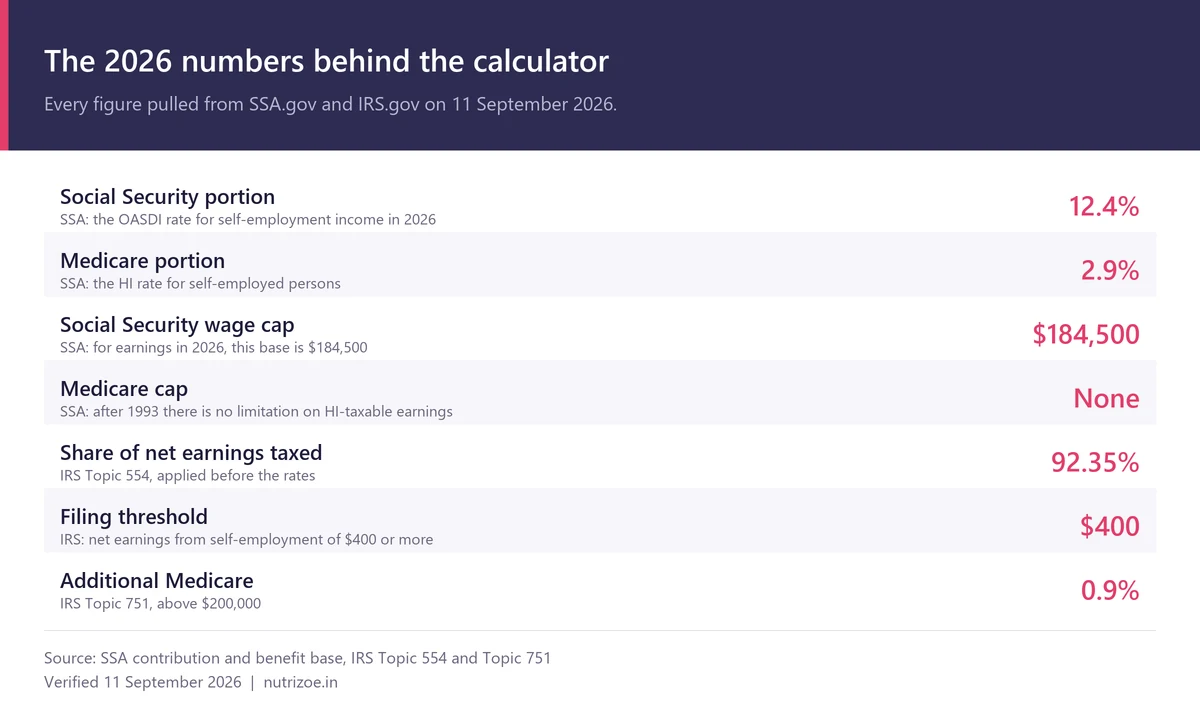
15.3% total, split two ways. The SSA sets the 2026 rate on self-employment income at 12.4% for Social Security and 2.9% for Medicare. On a payroll job your employer pays half of each. Working for yourself, you pay both halves, which is the entire reason the number shocks people the first time.
92.35% of net earnings, not 100%. The IRS states that generally the amount subject to self-employment tax is 92.35% of your net earnings. That trims the base slightly, and a calculator that skips it overstates your bill by roughly 8%.
The 2026 Social Security cap is $184,500. The SSA publishes this as the contribution and benefit base, and it moves every year with the national average wage index. Past that line the 12.4% stops. Medicare doesn't stop, because the SSA is explicit that after 1993 there has been no limitation on Medicare-taxable earnings.
$400 is the doorway. You usually must pay self-employment tax once net earnings reach $400. Below that the calculator returns nothing, which is correct rather than broken.
Why deductions matter more here than in a salary job
Drag the expenses slider and watch the total move. That responsiveness is the whole argument for bookkeeping.
Net earnings are gross income minus ordinary and necessary business expenses. Every dollar of legitimate expense removes a dollar from the base before the 15.3% is applied, which is why modelling deductions properly gives a very different answer from a tool that only looks at revenue.
The catch is evidence. A deduction you can't document is a deduction you don't have, which is why picking accounting software built for one person pays for itself in the first year. What actually qualifies is covered in the deductions guide.
One thing the slider deliberately doesn't model: retirement contributions. A Solo 401(k) or SEP contribution reduces your income tax, and it generally doesn't reduce self-employment tax, because the base is calculated before it. That distinction catches people out, and the plan comparison covers what those contributions do change.
Half of it comes back
The green line in the calculator is the part almost nobody accounts for.
The IRS allows you to deduct the employer-equivalent portion of your self-employment tax when figuring adjusted gross income. Roughly half of what you just paid reduces the income you're taxed on elsewhere. It doesn't refund the self-employment tax itself, and it does soften the combined bill more than people expect.
Which is why the headline 15.3% isn't the effective rate. The percentage under the donut is calculated against your actual net earnings, and it sits below 15.3% because of the 92.35% step. Watch it fall further once you cross the Social Security cap.
Turning the number into quarterly payments
The calculator divides by four because the IRS divides the year into four payment periods for estimated tax. Sole proprietors generally have to make those payments if they expect to owe $1,000 or more.
There's a safe harbour that removes most of the worry. The IRS states you generally avoid the underpayment penalty if you owe under $1,000 after withholding and credits, or if you paid at least 90% of the current year's tax, or 100% of the tax shown on your prior year return. Matching last year's total is usually the simplest route.
Income that arrives unevenly gets a concession too, since the IRS notes you may lower the penalty by annualising and making unequal payments. That fits side income far better than four identical instalments.
Before you rely on this
This is self-employment tax only. Income tax sits on top and depends on your bracket, filing status, credits and state, none of which the calculator can see.
Two other things it can't know. Whether you're a US tax resident at all, which is decided by a day count rather than your visa and is worked out in the substantial presence test. And, if you hold a work visa, whether the income-earning activity is authorised in the first place, which comes before any tax question.
If any of that income lands in an account back home, the reporting side opens up as well, and the FBAR guide covers when that applies.
Common questions
Is this self employment tax calculator free to use?
Yes. Free, no signup, nothing stored. Everything runs in your browser and no figures leave the page.
How much tax will I pay self employed, compared with a salary?
Roughly double what a salaried person pays on the same earnings, because no employer covers half. Working out how much tax I will pay self employed is what this calculator answers for the SE portion, and income tax then sits on top. The comparison line under the chart shows the difference on your own numbers.
Does a self employment tax calculator with dependents give a different answer?
Not for this tax. Dependents affect income tax through credits, and self-employment tax is charged on net earnings regardless of household. You would see the difference on the income tax side, which this page doesn't model.
Why does the 2026 calculation differ from 2025?
The rates are unchanged from 2025. What moved is the Social Security cap, so a high earner crosses it at a different point than a 2025 self employment tax calculator would show. Everyone under the cap sees identical maths to last year.
What if I also have a W-2 job?
Wages already taxed for Social Security count toward the same annual cap, so your self-employment income may face less of the 12.4% than this page shows. That combination is worth a professional's eye.
Does the 0.9% Additional Medicare line apply to me?
Only above $200,000, per IRS Topic 751, and the row stays hidden until your figures reach it. Thresholds vary by filing status, so treat the row as an indicator rather than a final figure.
Can I use this if I'm not a US tax resident?
Probably not as shown. Residency changes what is taxed and how, so settle that question first.
Nothing here is tax advice. Rates and the cap change annually, so this page carries the date they were checked and gets updated when they move. The sourcing rules are in the editorial policy, and if a figure has changed, tell me through the contact page.




Pingback: Substantial presence test calculator with the IRS formula
Pingback: SEP IRA vs Solo 401(k): the 2026 contribution comparison
Pingback: Moving back to India from USA: the money checklist