
Reviewed 11 September 2026. Figures on this page were checked against FinCEN and IRS.gov on that date. Contribution limits and thresholds change every year, so if a number here no longer matches its source, tell me and it gets corrected.
You kept the salary account open when you moved. There’s an old fixed deposit your father set up. Maybe a savings account you haven’t touched since college.
None of them individually look like much. Added together at their highest point last year, they might have crossed $10,000, and that’s the entire test. This page covers the fbar filing requirements for Indians living in the United States, which is the reporting obligation people most often discover two years late.
Written by Aradhana Sharma. Every figure here comes from IRS.gov or FinCEN and carries the date it was checked. I’m not a CPA or a tax attorney, and where this gets complicated the honest answer is to pay one.
What is FBAR filing, in one paragraph
Here is the one-sentence version. It’s an annual report of the foreign bank accounts you hold, filed with the Financial Crimes Enforcement Network rather than the IRS. That distinction matters more than it sounds, because it’s a separate filing from your tax return and submitting one doesn’t cover the other.
Most people assume it’s a tax. It isn’t. Nothing is owed on the accounts themselves. It’s a disclosure, and the cost of ignoring it is entirely about penalties rather than tax. That puts it in a different category from the deductions and tax planning most people think of first.
Do I need to file an FBAR, and do the FBAR filing requirements reach me?
Two conditions, and you need both. People routinely satisfy one and assume that settles it.
First, you’re a United States person for this purpose. That covers citizens and residents, and residency here follows tax rules rather than your visa stamp. The IRS applies the substantial presence test: your days here this year, plus a third of last year’s, plus a sixth of the year before. Most people on a work visa pass it, and the day count is worth doing properly rather than estimating. The same test decides how your US retirement account is treated.
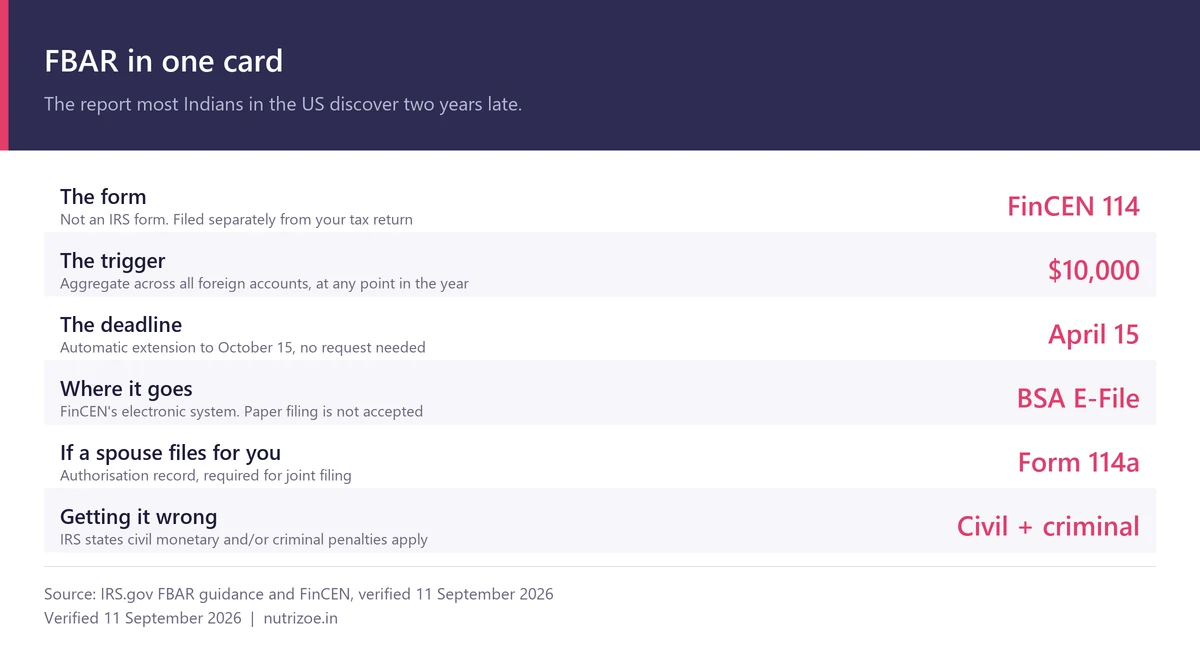
Second, you have a financial interest in or signature authority over foreign financial accounts whose aggregate value exceeded $10,000 at any time during the calendar year, per FinCEN. Read that twice. Aggregate, so every account added together. At any time, so a single day counts.
This is where the wrong answer usually comes from. They check each account separately, see nothing near $10,000, and stop. Three accounts holding the rupee equivalent of $4,000 each cross the line comfortably. So does one account that briefly held a property deposit before passing it on.
Signature authority catches people too. An account in a parent’s name that you can operate may count even though the money isn’t yours. If you’re still unsure after reading this, assume yes and spend an hour with a professional.
FBAR filing vs 8938: two forms, one confusion
These get treated as the same thing constantly. They aren’t, and filing one doesn’t satisfy the other. The confusion surfaces most often just after someone files one and wonders whether they’re finished.
The distinction starts with who receives each one. The FBAR goes to FinCEN through its own electronic system. Form 8938 is an IRS form and travels with your tax return. Different agency, different deadline mechanics, different form.
They also cover different ground, and how the IRS taxes nonresident aliens differs enough that your residency status changes which forms apply at all. The FBAR is about foreign financial accounts. Form 8938 covers specified foreign financial assets, a broader category that can include holdings which aren’t accounts at all. Its thresholds vary by filing status and by whether you live inside or outside the United States, and they’re higher than the FBAR’s $10,000. I’m deliberately not quoting those numbers here because they change and I would rather you read them from the IRS page on Form 8938 than trust a figure in a blog post.
Practically: many people who owe one owe both, and the overlap isn’t total. Work out each separately rather than assuming.
Can FBAR filing be extended?
Yes, and this is the one piece of genuinely good news on this page. It’s the rare question in this area with a painless answer.
The FBAR is due April 15 for the calendar year just reported. If you miss that, the IRS states you’re allowed an automatic extension to October 15. People usually expect a form and a reason. There’s neither. The IRS is explicit that you don’t need to request the extension.
So the extension is automatic and runs to October 15. Treating April 15 as the real deadline is still the better habit. The extension exists to catch people who forgot, and building your year around it means having no margin when something goes wrong.
How to do FBAR filing without paying someone
It starts with the system itself. You file electronically through FinCEN’s BSA E-Filing System, and there’s no paper option. Doing it yourself is realistic for a simple case, and the system costs nothing.
What you need before you start is the part that takes the time. For every foreign account: the institution’s name and address, the account number, the account type, and the maximum value it reached at any point during the year. That last figure is the one people scramble for, because it means pulling statements rather than checking a current balance.
If your spouse files on your behalf, that needs FinCEN Form 114a on record authorising it, and the jointly owned accounts have to be reported on a timely filed signed FBAR. For a couple, the thing that matters is that authorisation existing before the filing rather than after.
Handling it yourself doesn’t mean you always should. Where I would stop and pay someone: any year you were late, any account you’re unsure counts, and anything involving a trust or a business entity. The review methodology explains why I hold tax content to a different standard than software, and this is exactly why.
Is it easy to file FBAR? Honestly, mostly
The form itself isn’t hard. Most people worrying about this are worrying about the wrong part.
That’s the wrong question, because the difficulty is record keeping. The form itself takes an evening. Finding the peak balance on an account you closed in March, in a currency that moved all year, from a bank whose online statements only go back 12 months. That’s the work. Once you have the numbers, the submission is plain data entry.
Which is why the honest answer depends entirely on whether you kept a list. Build one in January covering every Indian account you hold, including dormant ones, the same way you would track business books through the year, and the annual version of this stops being stressful. The main guide puts this in the wider context of what else you’re reporting.
What happens if you haven’t been filing
This is the situation a lot of readers are actually in, so it deserves a direct answer rather than a warning.
The IRS states you may be subject to civil monetary penalties and criminal penalties for FBAR reporting and recordkeeping violations. The amounts depend on facts including whether the failure was willful, and they’re adjusted for inflation every year, so they sit on a page of their own with their source attached: what actually happens if you forgot to file an FBAR, including the six-year window the IRS has to assess anything at all.
What matters practically is that coming forward voluntarily is treated differently from being found. If you declared the income and simply missed the form, filing the late report yourself is realistic and the IRS says so in writing. If the income never made it onto the return, that’s the streamlined route, and it’s a job for a cross-border tax professional rather than a form you fill in hopefully. Pay for that advice. It’s the cheapest part of that situation.
Questions people ask
Does any of this apply on an H1B?
If you pass the substantial presence test you’re a US person for this purpose, and the rules land the same way they would on a citizen. Your visa category isn’t the deciding factor.
Does an NRE or NRO account count?
They are foreign financial accounts held outside the United States, so they count toward the aggregate. Both types. The label the Indian bank uses doesn’t change the US reporting position.
What if the account earns no interest?
Still counts. The trigger is the balance, not the income. This is the single most common reason people conclude wrongly that they’re under the threshold.
I’m on F-1. Does this reach me?
Possibly not. Certain days of presence are excluded from the substantial presence test for some student categories, which can leave you a nonresident and outside scope. Confirm your status before assuming either way.
Do I report the account or the money I sent to it?
The account, and specifically its highest value during the year. Money you transfer from already-taxed US income isn’t separately taxed on arrival, though it can push the balance over the threshold.
Is there a penalty for filing when I didn’t need to?
No. Filing unnecessarily isn’t an offence. Given the asymmetry between that and missing a required filing, erring toward filing is usually the calmer choice.
Does my 401(k) or US brokerage account go on it?
No. Those are US accounts. The FBAR covers accounts located outside the United States. What happens to your 401(k) if you leave is covered in the guide for H1B holders.
Do this in January, not April
If a move home is on the horizon, the departure checklist covers how this filing works in your final year. Whatever you concluded above about whether this reaches you, the next part takes ten minutes. Open a note. List every account you hold outside the United States, including the ones you think are empty. Next to each, write the highest balance it reached last year.
Add them up, and check where these figures came from if you want the sourcing. If the total crosses $10,000 at any point, you have a filing to make by April 15, with October 15 as the backstop. If it doesn’t, keep the note anyway, because next year’s answer may differ.
Nothing here is tax advice, and these rules interact with facts this page can’t know. It’s a map of the questions, so you can walk into a professional’s office knowing what to ask. The limits of what this site can tell you are in the about page and the disclaimer, and if a figure here has moved, tell me through the contact page.