


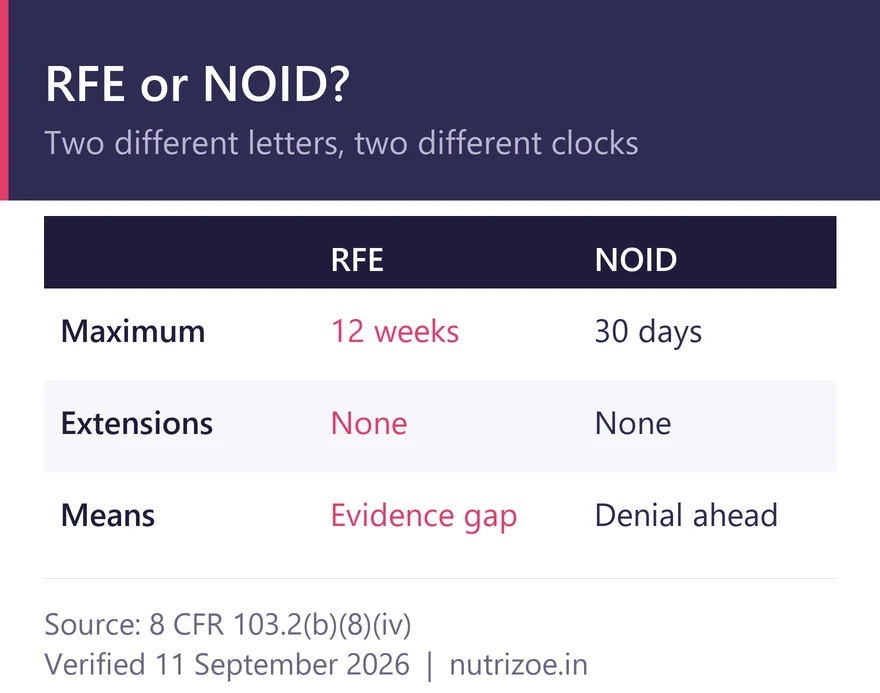
Twelve weeks. That’s the ceiling, it’s written into the regulation rather than left to an officer, and no extension exists.
Your H4 EAD RFE names a date. It can be shorter. It can never be longer.
Twelve years in the United States taught me what waiting on immigration paperwork does to a household, and how little of what you read while you wait is worth anything. I have not been through an H4 EAD adjudication myself and I will not write as though I have. What I can do is quote the regulation exactly and tell you where my knowledge stops.
Almost everything written about an H4 EAD RFE sits on forums, where the answers are other applicants guessing. The rule is public, so here it is.
The H4 EAD RFE response time, from the regulation
8 CFR 103.2(b)(8)(iv), the rule USCIS officers work to:
The request for evidence or notice of intent to deny will indicate the deadline for response, but in no case shall the maximum response period provided in a request for evidence exceed twelve weeks, nor shall the maximum response time provided in a notice of intent to deny exceed thirty days. Additional time to respond to a request for evidence or notice of intent to deny may not be granted.
8 CFR 103.2(b)(8)(iv)
Three things worth pulling out of that. Twelve weeks is a maximum, not an entitlement. A notice of intent to deny runs on a much tighter thirty days. And the final sentence removes the thing people spend the first week hunting for, which is a way to ask for more time.
USCIS says the same in its own Policy Manual, in plainer words: the maximum response time for an RFE is 12 weeks (84 days), and officers are prohibited from granting more. Same rule. Fewer commas.
Your outside date
Enter the date printed on the notice. This shows the twelve-week ceiling, which is the latest the deadline could possibly be.
Without JavaScript: count 84 days forward from the notice date. That is the ceiling, and your letter may say sooner.
The date on your letter governs, always. This is arithmetic on the regulation’s outer limit, not a reading of your notice, and posting time counts against you.
Reasons for an H4 EAD RFE
Here I have to be careful. I’d rather say why than pretend otherwise.
USCIS doesn’t publish a breakdown of H4 EAD RFE reasons, so any article ranking them is inventing the order. What can be said honestly is what people search for, and the search data is lopsided: photo problems and biometrics come up far more than anything else, alongside questions about the receipt notice never arriving.
An H4 EAD RFE for a digital photo usually means the image failed a specification rather than anything about your case. Size, background, glasses, how recent it is. The requirements sit in the Form I-765 instructions, and matching them exactly is cheaper than arguing.
The structural point is more useful than any list. An RFE means the officer thinks the record doesn’t yet establish eligibility, and 8 CFR 103.2(b)(8) gives them the choice to ask instead of denying outright. Being asked is better than the alternative, even though it doesn’t feel that way on the day.
H4 EAD processing time after an RFE response
No published figure exists for this, and I’m not going to make one up.
USCIS publishes processing times by form and service centre, and those move. The number that matters is the one on its own processing times tool for your receipt, on the day you look. Not a figure copied into a blog post in March. That one is wrong by June, and this subject is full of them.
What’s worth knowing structurally: your case goes back into the queue after you respond, and the clock you can control is the one before you post. Responding in week two rather than week eleven doesn’t speed up the adjudication, but it does remove nine weeks of risk that something goes wrong in the post.
Send everything, once
The Policy Manual tells officers to ask for everything they anticipate needing in a single RFE, and to avoid issuing a second one. That cuts both ways, and it’s the practical heart of a response.
Answer every item in the H4 EAD RFE, including the ones you think you already covered. Put the original H4 EAD RFE notice on top of the bundle. Keep a complete copy, photograph it, and post it so it’s tracked and arrives well before the date on the letter rather than on it.
Partial responses fail quietly.
That is the version of this that goes wrong without warning. The officer gets a package that answers three of four points and has no route left but to decide on what’s in front of them.
Where I stop, and an attorney starts
This page quotes a deadline. It doesn’t tell you what to put in your response. That line matters.
Whether a particular document answers a particular officer’s concern is a judgement about your case, made by someone who has read the letter. Get that wrong and the consequence isn’t a penalty you can pay later. The same rule applies here as on the page about freelance work on an H1B, which quotes the regulation and then sends you to an attorney rather than guessing on your behalf. H4 EAD denial reasons in particular are case-specific, and a forum thread describing somebody else’s denial tells you very little about yours.
The deadline is arithmetic. That part is yours to control.
While the EAD is pending
An RFE stalls the work authorisation. It doesn’t stall the tax year. That catches people out in April.
Your residency for tax purposes turns on days present, not on immigration status. So a delayed EAD doesn’t change which return you owe, and the substantial presence test is what settles it. The substantial presence test calculator settles that count, and if the answer surprises you there’s a separate question about whether you filed the right form in earlier years. Households that cross into resident status also come into range for FBAR reporting on accounts still held in India, and missing a year of that is fixable if you catch it.
Written by Aradhana Sharma. She spent twelve years living and working in the United States and moved back to India in 2019, so she has filed on both sides of this and from both directions. She advises small-scale businesses, has been self-employed for nine years and teaches business and finance on Udemy. She is not a CPA, an enrolled agent or an attorney. The regulation quoted here was read from the eCFR on 11 September 2026. Nothing on this page is legal advice, which is why it stops at the deadline and hands the rest to someone who has read your letter. If a rule changes and this page does not, the contact page is how it gets corrected, under the editorial policy.