Reviewed 11 September 2026. Figures on this page were checked against IRS.gov on that date. Contribution limits and thresholds change every year, so if a number here no longer matches…
Reviewed 11 September 2026. Figures on this page were checked against IRS.gov on that date. Contribution limits and thresholds change every year, so if a number here no longer matches…
Reviewed 11 September 2026. Figures on this page were checked against each provider's published fee schedule on that date. Contribution limits and thresholds change every year, so if a number…
Reviewed 11 September 2026. Figures on this page were checked against IRS.gov on that date. Contribution limits and thresholds change every year, so if a number here no longer matches…
Reviewed 11 September 2026. Figures on this page were checked against IRS.gov on that date. Contribution limits and thresholds change every year, so if a number here no longer matches…
Reviewed 11 September 2026. Figures on this page were checked against IRS.gov on that date. Contribution limits and thresholds change every year, so if a number here no longer matches…
Reviewed 11 September 2026. Figures on this page were checked against IRS.gov and FinCEN on that date. Contribution limits and thresholds change every year, so if a number here no longer matches its source, tell me and it gets corrected.
You moved for the job, or the degree, or the company transfer. Nobody handed you a guide to the money side, and the two countries you now file in don’t talk to each other.
NutriZoe covers NRI tax in the USA for Indians actually living here: what the IRS wants from you, what happens to your 401(k) if you go back, and which accounts in India you are obliged to report. Written by Aradhana Sharma, a financial consultant with 9 years inside self-employment and small business finance.
Every US figure here comes from IRS.gov or FinCEN with the date it was checked. Where a question crosses into Indian tax law or immigration law, this site says so and points you at someone licensed rather than guessing. That boundary is set out in how this site sources and checks facts.
The three things that catch people out
Almost every expensive mistake I see falls into one of these three.
Unreported accounts in India.The FBAR is the filing people miss most. FinCEN requires one from anyone with foreign financial accounts whose aggregate value exceeds $10,000 at any point in the calendar year. Aggregate, and at any point. A salary account, an old savings account and a fixed deposit can cross it between them while none of them individually comes close. If you’re reading that and realising you’ve missed a year, the IRS position on filing late is calmer than you’d expect. People check whether their Indian income needs declaring and stop there, missing that the account balance itself triggers a separate filing.
Cashing out a 401(k) on the way home.IRS Topic 558 adds a 10% additional tax on early distributions, on top of income tax, and leaving the country isn’t an exception. The full guide for H1B holders walks through the four options and what each one costs.
Assuming your visa decides your tax status. It doesn’t. The IRS uses the substantial presence test: all your days here this year, plus a third of last year’s, plus a sixth of the year before. You can run your own day count in about a minute. Pass it and you file as a resident, which is where US tax for NRIs stops resembling anything you read on an Indian finance site.
Work out where you stand
Retirement maths doesn’t change because you crossed a border, though your timeline might. This gives you a rough number to react to.
How far behind are you?
A rough self employed retirement plan calculator. Three inputs, no signup, nothing stored.
Projected at 65
Target pot (25x rule)
Gap
Assumes 6% average annual growth after inflation and retirement at 65. A rough sketch for orientation, not advice. The 2026 caps are in the table below.
NRI taxation in the USA: what you are actually filing
Two systems, and they use the same word to mean different things. NRI taxation in the USA barely resembles the Indian version, because in India NRI is a residency status that determines what India taxes, while the IRS doesn’t use the term at all. It cares only whether you are a resident or nonresident alien for tax purposes.
That mismatch is why NRI tax advice from Indian websites so often misfires. They are answering the India-side question. Once you pass the substantial presence test, the US taxes your worldwide income, and your filing becomes a resident return with foreign assets attached rather than anything exotic.
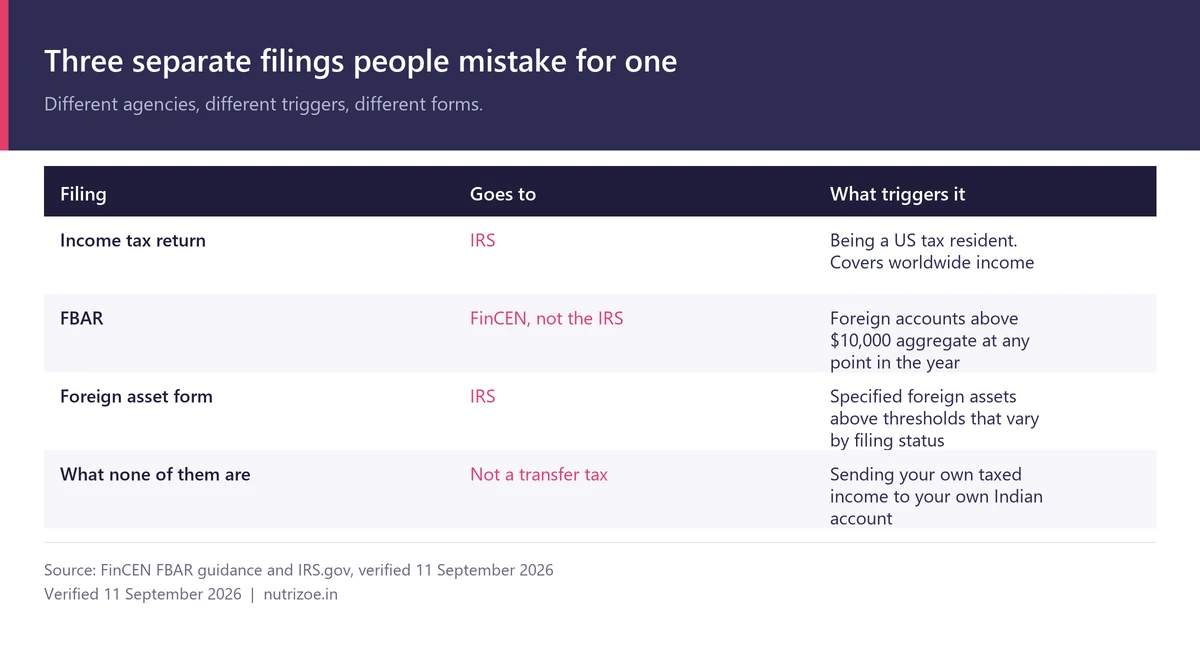
NRI tax filing in the US usually breaks into three separate obligations that people mistake for one. There’s the income tax return itself. There’s the FBAR, which is a FinCEN filing, not an IRS one, and goes in separately. And there may be an additional IRS form covering specified foreign financial assets, with thresholds that vary by filing status and whether you live in the US or abroad. Those thresholds change, so check the current ones on IRS.gov rather than trusting a number in a blog post, this one included.
Where NRI taxation in the USA gets genuinely hard is the overlap. The same income can be visible to both countries, and the India-US treaty exists to stop it being taxed twice. The IRS publishes the treaty documents if you want the primary text. Applying them to your situation is a cross-border professional’s job, and paying for one hour of that’s cheaper than most of the mistakes it prevents.
One thing worth saying plainly: filing late or filing wrong is recoverable, and not filing at all is the expensive path. The penalties attach to the omission, not to the error.
Verified against FinCEN and IRS.gov, 11 September 2026.
Foreign income, foreign assets, and money you send home
Three separate questions that get tangled together constantly. Untangling them is most of the work.
Income. NRIs who are US tax residents declare foreign income to the IRS, worldwide. Rent from a flat in Pune, interest on an Indian fixed deposit, dividends from an Indian mutual fund. All of it. The treaty may reduce what you ultimately pay, and it doesn’t remove the obligation to report. An NRI who declares foreign income late is in a far better position than one who never declares it at all.
Assets. Whether NRIs have to declare foreign assets is a separate question about balances rather than earnings. The FBAR threshold is the aggregate peak across all foreign accounts crossing $10,000 at any moment in the year. An account earning nothing still counts toward it. People usually think only of accounts they earn from, which is how NRIs cross the threshold on foreign assets without noticing.
Remittances. There’s no NRI remittance tax in the USA, and the confusion is understandable, because India applies a collection mechanism to certain outward remittances that has no US equivalent. Sending your own already-taxed US income to your own account in India is a transfer of your own money. The thing worth asking about is the reporting side rather than a tax on the transfer itself, because moving money into an Indian account can push that account’s balance over a threshold that triggers a filing.
NRI foreign income disclosure is therefore a two-part habit: report the income on the return, and report the accounts through FinCEN. Doing one and not the other is the most common gap. Treat NRI foreign income disclosure as a checklist you run every January, listing every Indian account you hold including the dormant ones, and the annual version of this stops being stressful.
Nothing above is tax advice, and the specifics depend on facts this page can’t know. It’s a map of which questions exist, so you walk into a professional’s office knowing what to ask.
What is a good retirement plan for self employed people
It depends almost entirely on two numbers: what you earn, and whether you employ anyone. That’s the whole decision tree, and everything else is detail.
If you’re starting from nothing, the full freelance retirement planning walkthrough is the place to begin. From there the first real fork is whether a SEP IRA or a Solo 401(k) suits your income shape, and that single choice costs more to get wrong than anything else on this site. People want one answer to cover everyone, and the honest response is that a solo operator earning $60,000 and one earning $300,000 belong in different structures.
Self employed retirement plan contribution limits for 2026
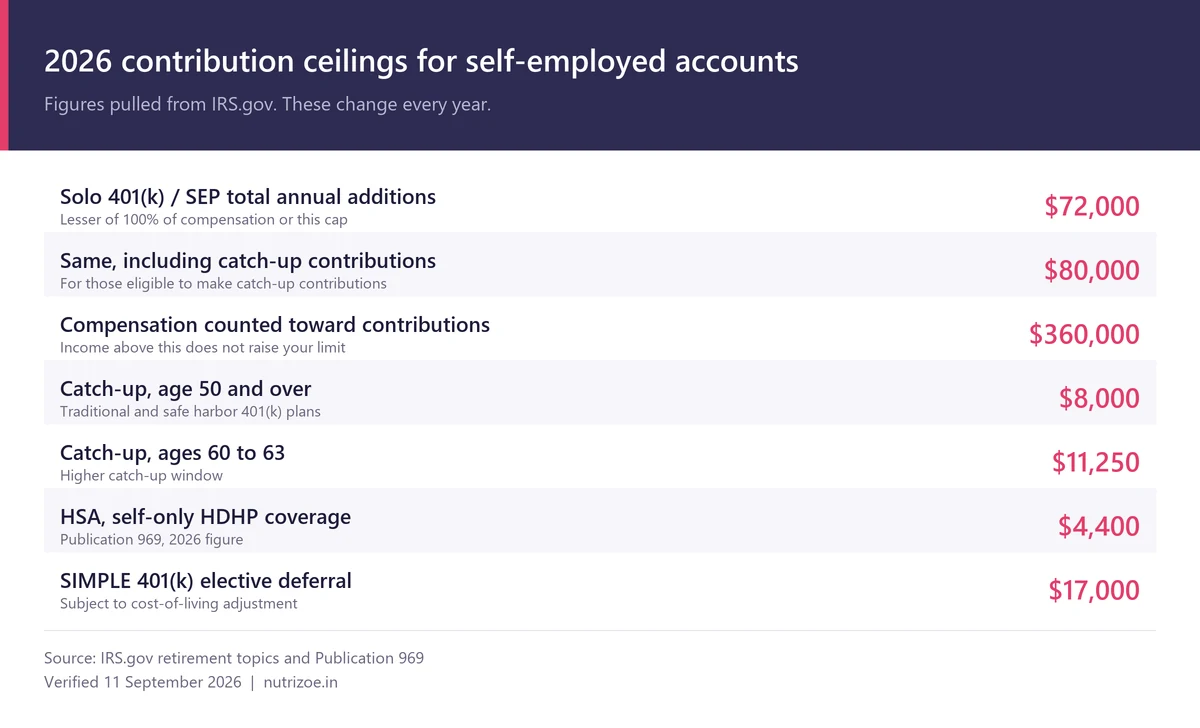
These move every year, and a stale figure is worse than no figure. The self employed retirement plan contribution limits below were pulled from the IRS retirement plans section and Publication 969 on 11 September 2026.
Verified against IRS.gov on 11 September 2026. Figures change annually.
Two things people miss. The $360,000 compensation cap means income above that line stops raising your limit, which changes the maths for high earners considering a defined benefit structure. And the catch-up window between 60 and 63 is larger than the standard one at $11,250, so timing matters. Both are covered in the Solo 401(k) guide, and the explainer on target-setting shows what those self employed retirement plan contribution limits mean against a real target.
How to save for retirement as a freelancer when income swings
This is the part that actually breaks. Opening the account takes an afternoon. Feeding it through a quiet quarter is the hard bit, and it’s where most freelance retirement planning quietly dies.
The workable answer is percentage-based transfers that fire on payment rather than on a calendar date, which is exactly what the guide to automating contributions builds out step by step. The standard advice on saving for retirement as a freelancer is to “pay yourself first”, which is useless when your income arrives in irregular lumps. A retirement plan for freelancers has to survive a bad month without needing a decision.
Where the money goes matters too. The platform comparison ranks providers on published fee schedules, and for anyone weighing property against index funds, the real estate breakdown covers what that does to your liquidity.
Tax, and the systems that make deductions provable
Self-employment tax surprises people every single year, and the fix is structural rather than clever. Work out what you actually owe before deciding how much to set aside. What you can legitimately claim is laid out in the deductions guide, though a deduction you can’t evidence is a deduction you don’t have.
Software and AI tools, after somebody has actually used them
Every tool here has been used on paid client work for at least 2 weeks before anything gets written, and the tools section collects them all in one place. The review methodology sets out what else has to happen first, and the results are frequently unflattering to the popular option.
On the AI side, a six-month-old verdict is close to worthless, so these get re-checked more often than anything else. The Claude Code beginner guide is the longest piece on the site and includes the parts that broke. When I handed an agent control of my own machine for a week, the write-up leads with what went wrong, and the model head-to-head covers where each one falls down.
Matching the account to your situation
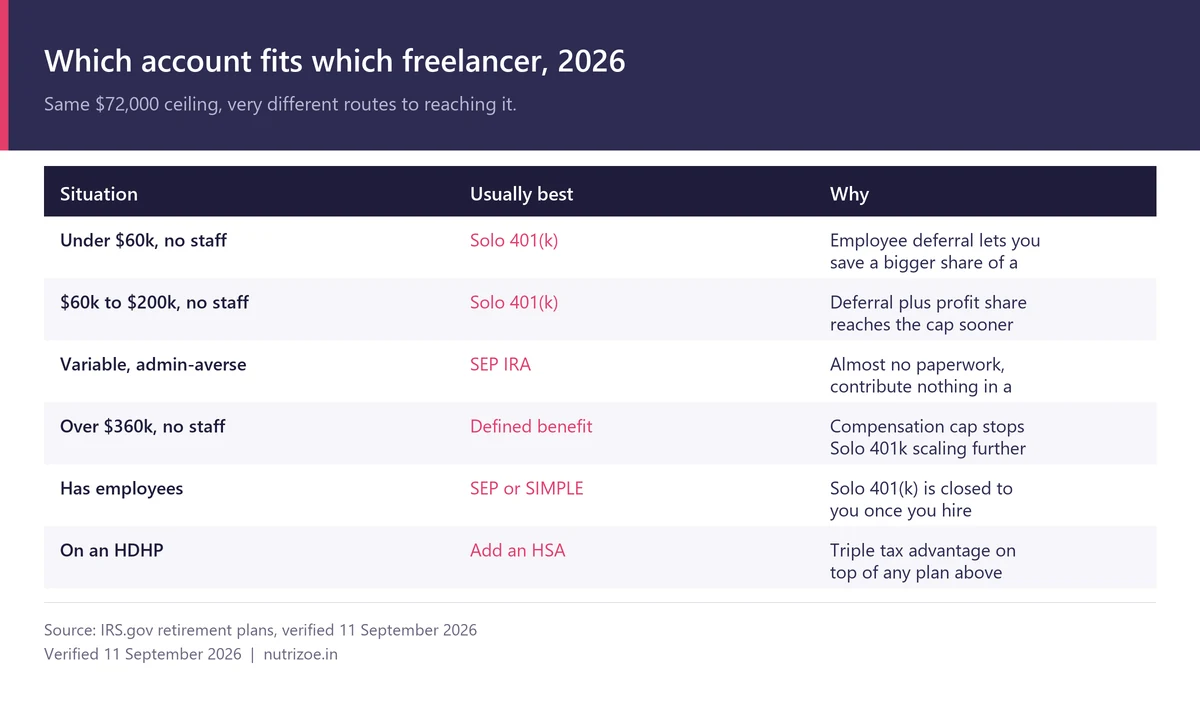
Two solo operators with identical revenue can belong in different accounts, because the deciding factors are staff, stability and where your income sits against the compensation cap. Here’s the short version.
Rules verified against IRS.gov on 11 September 2026.
The row that trips people up is the third one. Simplicity has real value when your income is unpredictable, and a SEP IRA you actually maintain beats a Solo 401(k) you abandon after two quarters of paperwork. I’ve watched that happen often enough to stop treating the theoretically optimal answer as the right one.
The last row is the one most people skip entirely. If you’re on a high-deductible health plan, an HSA sits on top of whatever else you’re doing, and the triple tax advantage explains why it beats almost every other account on a per-dollar basis. It’s the closest thing to a free upgrade in this whole area.
Hiring changes everything, and it changes it immediately. The moment you take on an employee, the Solo 401(k) closes to you, which catches people mid-year. If that’s on your horizon within 18 months, factor it in now rather than unwinding a structure later.
The order to do all of this in
Sequence matters more than people expect. Doing the right things in the wrong order wastes years, and I’ve watched capable freelancers stall at step 2 for most of a decade.
Separate the money. A business account and a personal account, with nothing crossing between them casually. Every deduction you’ll later claim depends on this being clean, and it takes an afternoon.
Cover three months of costs. Before any retirement account. A cash buffer is what stops you raiding a tax-advantaged account during a slow quarter, and hardship withdrawals carry penalties that make them a bad emergency fund.
Set aside tax on every payment. A percentage moved the day money lands, not a lump found in April. Self-employment tax is the single most common cash-flow shock in freelance retirement planning.
Open the account. Now, and only now, pick the structure. For most people the honest answer to what is a good retirement plan for self employed income is a Solo 401(k), though a SEP IRA wins in specific cases.
Automate the contribution. Percentage-based, triggered on payment. This is the step that decides whether any of the previous four mattered in five years.
Review once a year. Contribution limits move annually. So does your income. A retirement plan for freelancers that never gets revisited drifts out of date quietly.
Anyone working out how to save for retirement as a freelancer tends to jump straight to step 4, because picking an account feels like progress. It isn’t, if steps 1 to 3 are missing. The planning guide walks the full sequence, and the deductions breakdown explains why step 1 pays for itself.
The mistakes that cost the most
Four of them, in rough order of expense.
Waiting for a good year. The plan is always to start saving properly once income stabilises, and income never does. Ten years of small contributions beats three years of large ones, because the compounding window matters more than the amount. Any self employed retirement plan calculator will show you this in about fifteen seconds, including the one further up this page.
Picking the wrong structure and staying in it. A SEP IRA is simpler to open, which is why people choose it, and then they discover the employee deferral they gave up. The side-by-side comparison runs both at several income levels, and the answer flips depending on where you sit.
Ignoring the compensation cap. High earners assume more income means a bigger contribution ceiling. It stops at $360,000 of counted compensation for 2026, which is the point where a defined benefit structure starts to make sense.
Treating the retirement account as an emergency fund. It’s the most expensive money you own. Building the buffer first is the whole reason step 2 sits above step 4 in the sequence above.
Who this site is written for
Freelancers, contractors, consultants and solo business owners filing self-employment income in the United States. If you receive 1099 income, work through platforms, or run a single-member business, the material here is aimed at you.
The freelance retirement planning coverage assumes US tax rules throughout, so contribution figures come from the IRS and reference US account types. Readers elsewhere will find the principles portable and the numbers wrong, and I’d rather say that plainly than let someone act on a figure that doesn’t apply to them.
It’s also written for people early enough to still be working out what a good retirement plan for self employed income looks like. If you already have a CPA managing a defined benefit plan, most of this will be familiar. If you are on a work visa and wondering whether side income is even permitted, the guide on freelance work and H1B status covers what the regulation says and where an attorney becomes necessary. The tools coverage suits anyone running a one-person operation, whatever they earn, and a good starting point there’s the browser extension roundup or the note-taking comparison.
Questions people ask before they start
What is a good retirement plan for self employed people earning under $100,000?
Usually a SEP IRA or a Solo 401(k), and the Solo 401(k) wins more often than people expect because the employee deferral component lets you contribute a higher share of a modest income. The full comparison runs the numbers at several income levels.
How to save for retirement as a freelancer with no steady income?
Move a fixed percentage of every payment the day it clears, rather than a fixed amount on a fixed date. A bad month then costs you a smaller transfer instead of a skipped one. The automation guide covers the mechanics.
Do the self employed retirement plan contribution limits include employer contributions?
Yes. When you work for yourself you are both employee and employer, and the $72,000 total annual additions cap for 2026 covers both sides combined. The walkthrough of the two contribution sides shows how the split works.
Is a self employed retirement plan calculator accurate enough to plan around?
For orientation, yes. For decisions, no. Any self employed retirement plan calculator, including the one on this page, assumes a fixed growth rate that reality won’t deliver. Use it to find the rough size of the gap, then read the calculator explainer for what the assumptions hide.
Can I open a retirement plan for freelancers if I also have a day job with a 401(k)?
Often yes, though the employee deferral limit is shared across both plans while the employer side is counted separately for each. That’s where a retirement plan for freelancers gets genuinely complicated, and it’s worth paying a professional for an hour.
How late is too late to start?
Sixty is late. It’s not too late, because the catch-up window between 60 and 63 allows $11,250 on top of the standard limit, and someone working to 70 still has a decade of contributions ahead of them. The catch-up rules sit in the IRS catch-up contribution guidance, and they’re more generous than most people assume. The arithmetic gets harder as you go, and it doesn’t stop working.
Should I pay off debt or contribute first?
Anything above roughly 7% interest, clear it first, because you won’t reliably beat that return in a market. Below that, run both at once. Credit card debt is the clear case for pausing contributions; a low-rate loan almost never is.
Is US tax on NRIs different from how India taxes me?
Completely. India decides what it taxes using its own residency rules. The US ignores the term NRI entirely and asks whether you are a resident alien for tax purposes. Two systems, two answers, and the question only makes sense once you know which side you are asking about.
Does my filing change if I’m on a student visa?
It can. Certain days of presence are excluded from the substantial presence test for some visa categories, which can leave you filing as a nonresident. That single distinction changes your US filing more than almost anything else, so confirm your status before assuming.
How is rental income from a flat in India treated?
If you are a US tax resident, it’s reportable income. The India-US treaty may affect the final tax while leaving the reporting requirement fully in place. That’s the most common gap I see.
Is there an NRI remittance tax in the USA?
No. The US doesn’t tax you for moving your own already-taxed money to India. Most of the confusion comes from an Indian collection mechanism on outward remittances, which is a different thing entirely. Gift rules are separate again and worth checking if amounts are large.
Do NRIs declare foreign income already taxed in India?
Yes, if you are a US tax resident. Declaring it and paying twice on it are different questions, and the treaty exists to address the second. Reporting comes first either way.
Do NRIs declare foreign assets that earn nothing?
For FBAR purposes, yes. The trigger is the aggregate balance crossing $10,000 at any point, not whether the account earned anything. Declaring foreign assets is a balance question rather than an income question.
What does good disclosure look like in practice?
A January list of every Indian account you hold, including dormant ones, with each account’s highest balance during the year. Good NRI foreign income disclosure is mostly record-keeping rather than expertise.
Where do the figures on this site come from?
Primary sources, on the day of writing, with the date shown. IRS for contribution limits, and the Social Security Administration for the wage base that sets your self-employment tax ceiling. The full rule is in the editorial policy.
Where to start, depending on where you are
Four common starting points, and the shortest route out of each.
You have nothing set up and you’ve been meaning to for years. Run the calculator at the top of this page to see the size of the gap, then read the planning walkthrough end to end. It’s long, and it’s the only thing on this site I’d call required reading. Give it an hour on a quiet afternoon rather than skimming it on a phone.
You have an account but you’re not sure it’s the right one. Go straight to the comparison and check your income against the table above. Switching structures is inconvenient but rarely difficult, and the cost of staying in the wrong one compounds quietly for years.
You’re contributing but it’s inconsistent. This is the most common situation and the easiest to fix. The automation walkthrough covers percentage-based transfers, and the three-system approach handles income that arrives in lumps.
You’re behind and you know it. Start with the material on starting late, then look at whether an HSA gives you a second contribution channel you’re not using. Being behind at 45 with a plan beats being on track at 35 without one.
What this site doesn’t cover
Worth being explicit, because knowing the boundaries saves you time. A site that claims to cover everything usually covers nothing well, and I would rather send you elsewhere than pad this one out.
No stock picks, no market timing, no cryptocurrency, and no commentary on where the economy is heading. Those attract traffic and I have nothing useful to add to them. There’s also no coverage of employer-sponsored benefits, corporate 401(k) administration, or anything that assumes you have an HR department.
Non-US tax systems are outside the scope too. The retirement material assumes IRS rules and US account types throughout, so a reader in the UK or India will find the structure familiar and the numbers useless. And nothing here is personalised advice, which is a limitation rather than a disclaimer: a real recommendation needs your full picture and a licence I don’t hold.
What’s left is a narrow subject covered properly. Freelance retirement planning, self-employment tax, and the software a one-person business actually runs on.
How this site works
One writer, named and credentialed. Primary sources for every figure. Dated reviews on anything that changes annually. Corrections noted rather than quietly edited.
The site runs on display advertising alone, described in the disclosure page. No link here earns a commission, so nothing in a recommendation has a revenue reason to be there. The limits of what this site can tell you matter here, because this is money content, so they’re spelled out in the about page and the disclaimer. Nothing on this site is personalised financial advice.
Found an error, or a limit that’s moved? The contact page is the fastest way to reach me, and corrections get priority over everything else in the inbox.