

The flight is the easy part of moving back to India. The money you leave behind is what follows you.
Most people planning a return sort out shipping, schools and the visa question, then discover in April that the tax year they just lived through is split in half and filed differently. This is the money checklist for moving back to India from the USA, written in the order the decisions actually arrive.
By Aradhana Sharma. Every US rule here was read from IRS.gov on 11 September 2026. The India side has its own rules and its own professionals, and this page is careful to say where that line falls.
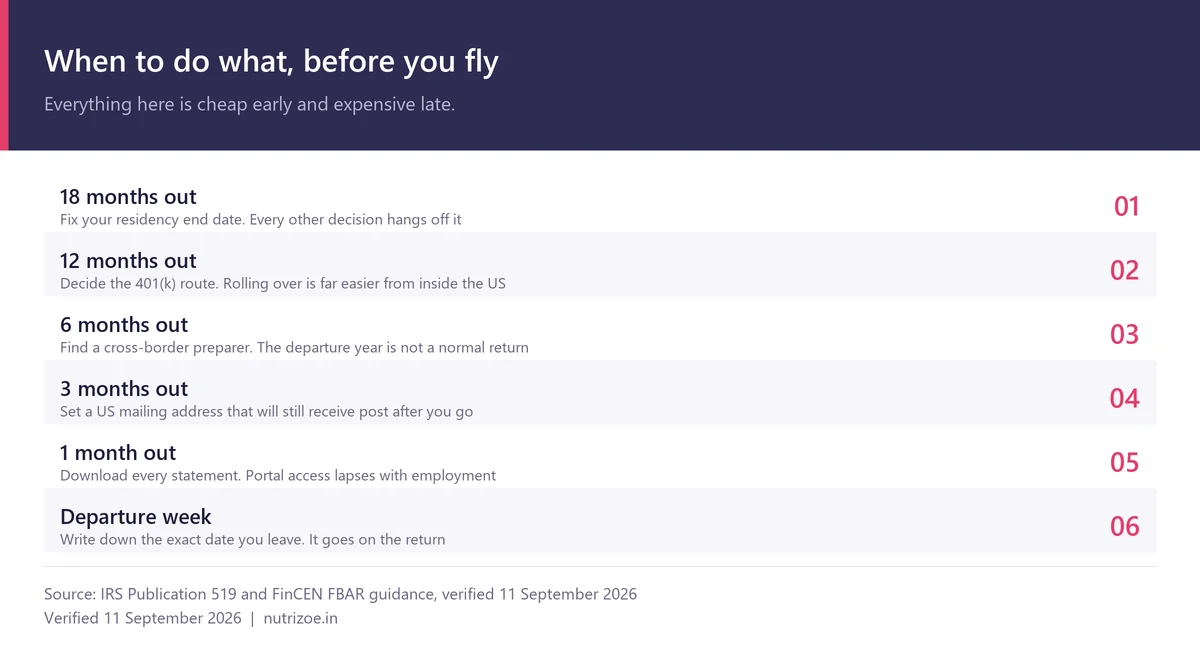
Start eighteen months out, not eighteen days
Almost everything below is cheap if you do it early and expensive if you do it in the last fortnight. That’s the single most useful thing on this page.
The reason is timing rather than paperwork. Which calendar day you stop being a US tax resident changes what gets taxed, and you can influence that date far more before you book the flight than after. Anyone working out how to move back to India from the USA should settle the date question first and let everything else follow from it.
Your departure year is a dual-status year
This is the part almost nobody knows about until a preparer explains it, and it shapes everything else.
The IRS states it directly: you’re a dual-status individual when you’ve been both a US resident and a nonresident in the same tax year, and “the most common dual-status tax years are the years of arrival and departure”. Your leaving year is one of them almost by definition.
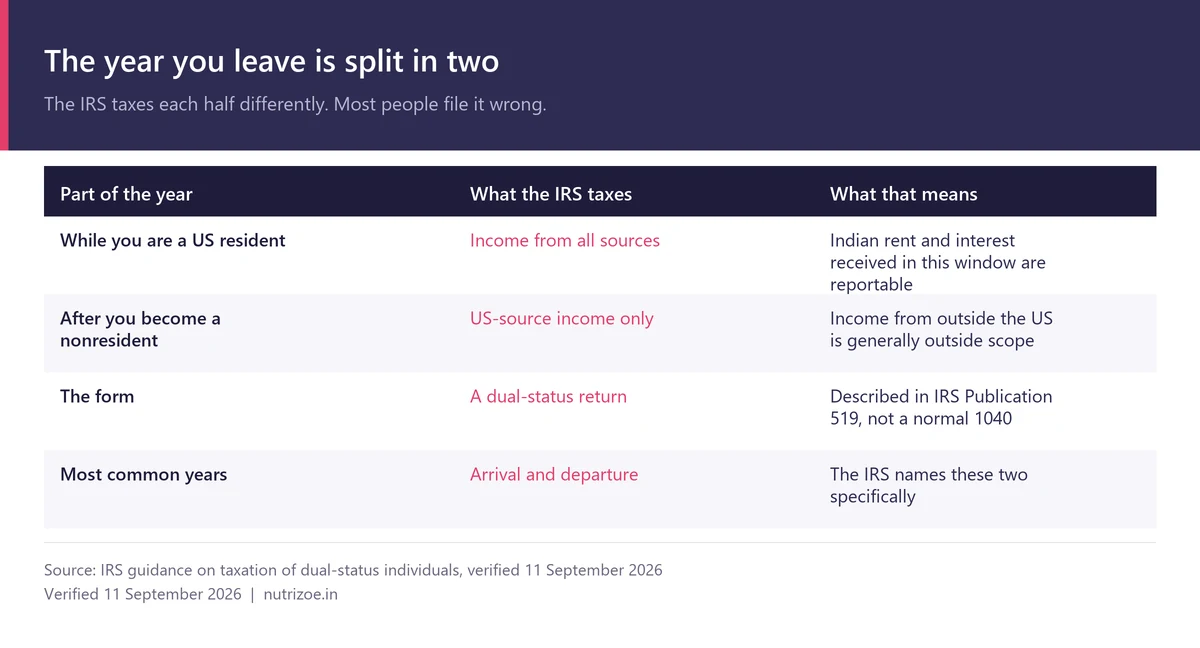
Read what that split does. For the resident part of the year you’re taxed on income from all sources, so rent from a flat in Pune received in that window is reportable. For the nonresident part you’re taxed on US-source income only, and income from outside the US that isn’t connected to a US trade or business generally falls outside scope.
Which is why the date matters so much. A large payment landing on one side of that line rather than the other can change its treatment entirely. The return itself is a dual-status return, described in IRS Publication 519, and it’s the one year to pay a professional even if you’ve always filed your own.
The 401(k) decision, and the mistake that costs most
People cash out on the way to the airport. It’s the single most expensive thing on this list.
Leaving the country isn’t an exception to the early withdrawal rules. IRS Topic 558 applies a 10% additional tax on early distributions on top of ordinary income tax, and relocation isn’t on the list of exceptions. On a mid-sized balance that’s a five-figure decision made under time pressure.
The account doesn’t care where you live. It stays invested, and you can leave it, roll it to an IRA, or wait until 59 and a half when the extra 10% no longer applies. The one detail worth handling before you fly is a small balance: IRS guidance says an account between $1,000 and $5,000 may be moved into an IRA in your name if you neither elect payment nor roll it over yourself. The full guide to that decision runs through all four routes and what each costs.
Moving back to India from USA tax implications, in order
Five things, roughly in the sequence they bite. The first one leans on the substantial presence calculator, and the third on the FBAR guide, so open both alongside this.
- Fix your residency end date. Your day count decides when US tax residency stops. Everything downstream depends on this number.
- File the dual-status return properly. Two halves, two treatments, one return. Publication 519 is the reference, and a cross-border preparer is worth the fee in this specific year.
- Settle the FBAR question for the final year. If you were a US person for part of the year and your foreign accounts crossed $10,000 in aggregate at any point, the filing is still live. The threshold looks at the peak during the year, not the balance on the day you left.
- Decide on the retirement accounts before you fly. Not because of a deadline, but because doing it from 8,000 miles away with a closed US phone number is genuinely harder.
- Keep a US address that receives post. Plan administrators, brokerages and the IRS all send paper. A friend’s address or a mail service costs almost nothing and prevents the most common practical problem.
Those five are the US side, and they’re the half this site can source properly. The Indian side of moving back to India from USA tax implications runs on Indian residency rules, and it deserves its own professional rather than a paragraph here.
Moving back to India from USA transfer money questions
Two separate things get confused constantly here, and separating them removes most of the anxiety.
Moving your own already-taxed savings from a US account to an Indian one is a transfer of money you already own. The US doesn’t tax you for moving it. What it can do is push the receiving account’s balance over a reporting threshold, which is a disclosure question rather than a tax one.
The part worth planning is timing and rate, not tax. A large transfer executed in one lump on a bad exchange rate day costs real money, and nothing about the tax code changes that. Anyone researching moving back to India from USA transfer money advice will find a lot of content about remittance products and very little about the reporting side, which is the half that carries penalties.
The account types you move into, and how India treats them once you’re resident again, sit under Indian banking regulation. That’s genuinely outside what this site can source, and I’d rather say so than paraphrase a rule I haven’t read at source.
Should I move back to India from the USA?
Not a question a finance page can answer, and the honest version is more useful than a framework.
People asking should I move back to India from the USA are usually weighing family, career and where they want their children to grow up. Money rarely decides it. What money can do is stop a decision already made from becoming expensive, which is the whole purpose of the checklist above.
One financial point does belong in the decision though, and it gets missed. Retirement accounts built in the US keep compounding whether you live in Mumbai or Michigan. Whether it’s worth moving back to India from the USA financially depends far less on what you give up than on what you keep intact, and people routinely liquidate things they could simply have left alone.
What to do in the last month
Short list, because by this point the big decisions are behind you.
Download every statement you might need for the dual-status return, because portal access tends to lapse once an employer relationship ends. Note the highest balance each foreign account reached during the year while the records are still in front of you. Confirm the mailing address on every US financial account. And write down the date you physically leave, because that number appears on the return.
If you’re self-employed rather than on a payroll job, the self-employment tax calculator gives you the final-year figure to set aside before the income stops.
Questions people ask
Does moving back to India from USA mean I stop filing US returns?
Not immediately, and not always. Your final year is a dual-status year that still requires a return, and US-source income can keep a filing obligation alive afterwards. Confirm your position rather than assuming it ends with the flight.
Can I keep my US brokerage account after I return?
Some firms allow it and some close accounts for non-US addresses. Ask your provider directly before you go, because discovering the answer afterwards is considerably harder.
What happens to my Social Security contributions?
Contributions made stay on your record. Whether you eventually receive anything depends on total credits and the rules in force at the time. The IRS guidance for taxpayers abroad covers the filing side, and the benefit side is a question for the Social Security Administration rather than a blog.
Is it worth moving back to India from the USA if I have a green card?
That adds an immigration dimension well beyond the money, since extended absences can affect status. An immigration attorney, before anything else.
Do I still need to file an FBAR for my departure year?
Likely yes, if you were a US person for part of that year and the aggregate crossed $10,000 at any point. The threshold looks at the peak during the calendar year, not the balance on the day you left.
Should I sell US investments before leaving?
Selling creates a taxable event whose treatment depends on which side of your residency end date it falls. That timing question is exactly why the date comes first on the checklist.
How long before the move should I start?
Eighteen months is comfortable, six is workable, one is where mistakes get made. The tax decisions need a full calendar year in view to plan around.
Where this page stops
Everything above is the US side, sourced to the IRS and dated. That’s the half I can verify.
Indian tax residency, FEMA rules, and how your accounts get reclassified once you’re resident in India again are governed by Indian regulation. Get those from an Indian chartered accountant who handles returning NRIs, not from a US-focused site. Plenty of pages will give you both halves confidently. Ask yourself where they read the Indian half.
Nothing here is tax advice. Rules and thresholds change, so this page carries the date its figures were checked. The sourcing rules are in the editorial policy, the limits are in the disclaimer, and corrections go through the contact page.





Pingback: Forgot to file an FBAR? What actually happens next
Pingback: Filed a 1040 instead of a 1040NR? How to fix the return
Pingback: FICA withheld on OPT? How to get your FICA tax refund