

SEP IRA vs Solo 401(k): Which is the Best Retirement Plan for You?
Table of Contents
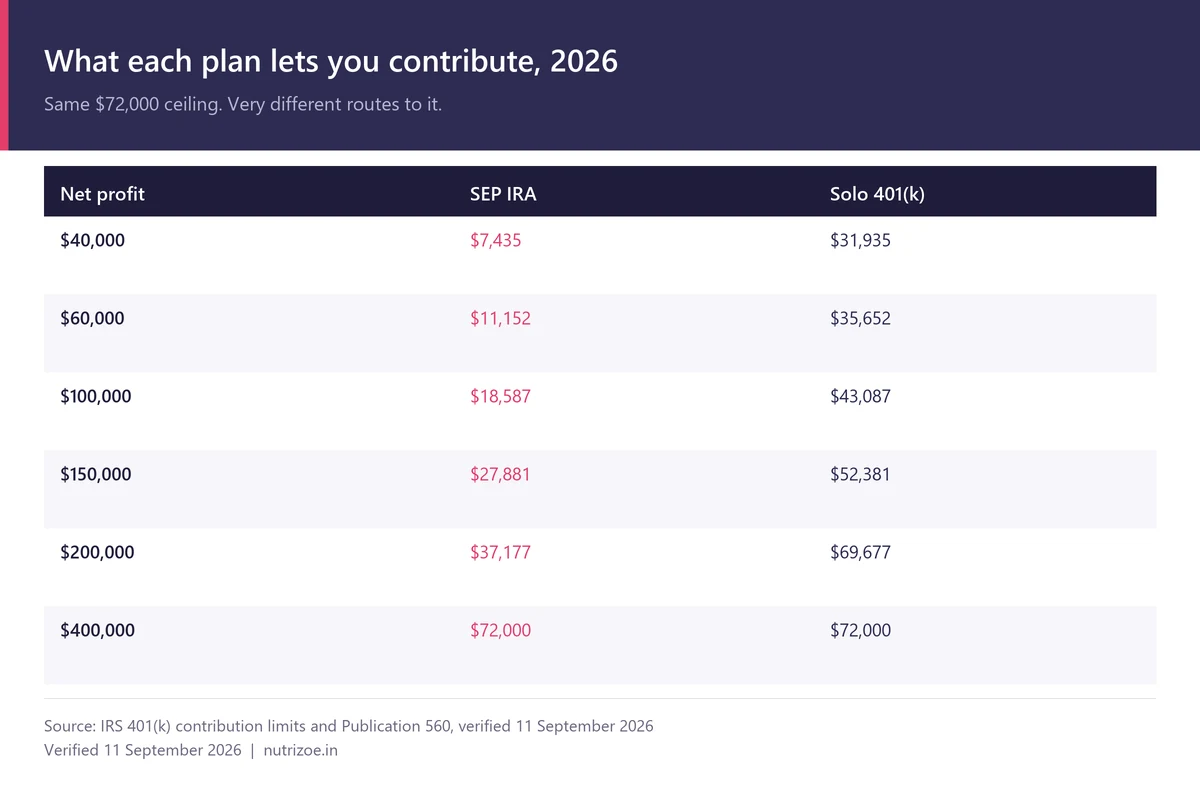
The comparison table below is effectively a SEP IRA vs Solo 401(k) calculator: enter your net profit and it applies the SEP IRA contribution limits for 2026 and the Solo 401(k) equivalents at once. You’re self-employed. You earn good money. And every tax season you wonder the same thing: am I using the right retirement account?
If you have not settled whether you are even a US tax resident, start with the day count, because it changes what any of this is worth. The choice between them is the single most important financial decision most freelancers, independent contractors, and small business owners will make in 2026. Get it right and you could shield an extra $24,500 to $56,000 from taxes in a single year. Get it wrong and you hand that money straight to the IRS.
Run it on your own numbers
2026 limits. Sole proprietor or single-member LLC. Nothing is stored.
SEP IRA
- Employer share
- Employee deferralNot available
- Catch-upNot available
Solo 401(k)
- Employer share
- Employee deferral
- Catch-up
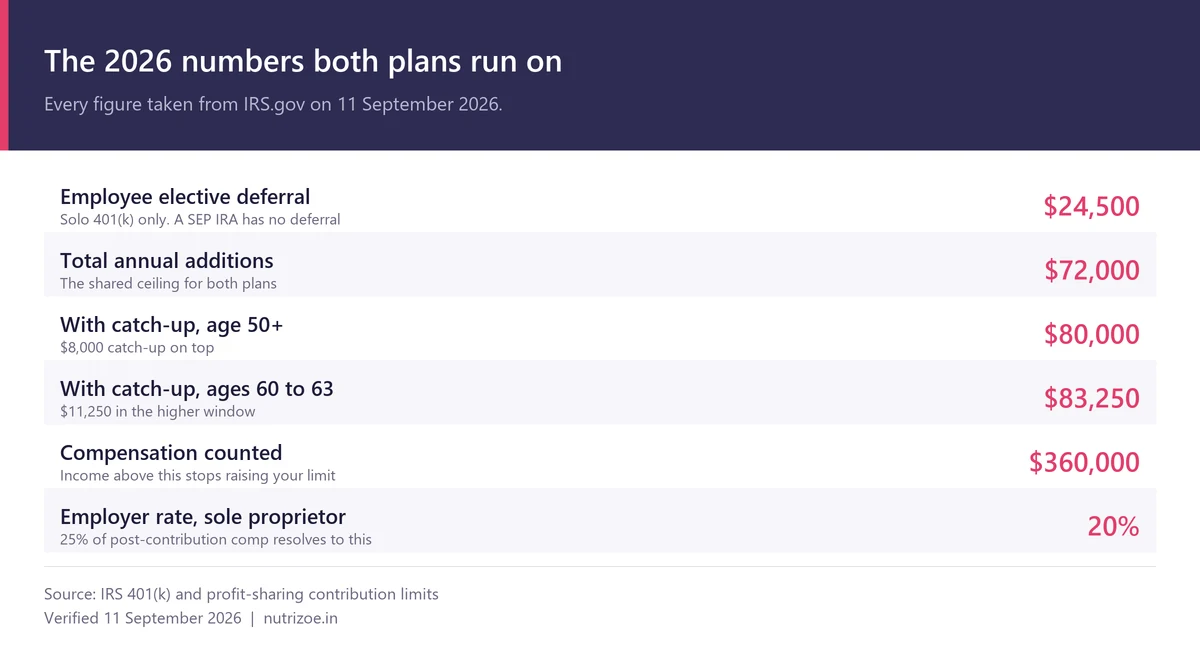
Both plans share the $72,000 annual additions cap for 2026, so at high income they converge. The 25% employer rate resolves to 20% of earned income for a sole proprietor, because the contribution reduces the compensation it’s calculated on. Publication 560 has the exact worksheet.
This isn't a simple answer. The best freelance retirement account depends entirely on your income, your age, your business structure, and how aggressively you want to build wealth. This retirement plan comparison will give you every fact you need to decide, with zero fluff and zero bias.
Analysing the core architecture of freelance retirement accounts
Before comparing them directly, you need to understand what each account actually is. They are built differently at a structural level, and that structure determines everything.
A SEP IRA, Simplified Employee Pension, is an individual retirement account funded entirely by employer contributions. If you're self-employed, you're the employer. You contribute a percentage of your net income, up to 25% of compensation or $72,000 in 2026, whichever is less. There's no employee contribution component. There's no catch-up contribution for workers over 50. It's one lever, and that lever is tied directly to your income.
A Solo 401(k), also called an individual 401(k) or one-participant 401(k), is a full 401(k) plan designed for a business owner with no full-time employees other than a spouse. It has two contribution components: an employee elective deferral and an employer profit-sharing contribution. That two-lever structure is the foundation of every advantage this account holds over the SEP IRA.
Why the brokerage industry steers you toward the SEP IRA
The SEP IRA is simpler to open, simpler to maintain, and generates fewer questions from clients. For brokerage firms managing thousands of accounts, simplicity scales. But simplicity for them costs you real money in retirement savings.
81% of self-employed people wish they had learned about saving for retirement earlier, and a significant part of that regret traces back to choosing the easier option over the better one. The SEP IRA works perfectly well. For most people earning under $280,000 a year, the Solo 401(k) simply lets you put away more.
The dual-capacity mechanism: acting as employee and employer
This is the core structural advantage of the Solo 401(k). When you open a Solo 401(k), you wear two hats simultaneously.
As the employee, you can defer up to $24,500 in 2026 regardless of your profit percentage. This is a fixed floor, it doesn't shrink when your income drops.
As the employer, you can add up to 25% of your W-2 compensation or 20% of your net self-employment income in addition to that deferral.
The SEP IRA gives you only the employer hat. There's no employee deferral. One lever instead of two.
SEP IRA vs Solo 401(k) for freelancers earning 100k: A head-to-head battle
This is where the retirement plan comparison gets concrete. At a $100,000 net income level the gap isn't marginal, it's enormous.
Consider a 45-year-old consultant with $150,000 in net adjusted self-employment income: with a SEP IRA, the maximum contribution is 25% of compensation, totaling $37,500. With a Solo 401(k), they can contribute $24,500 as the employee plus $37,500 as the employer, for a total of $62,000, an extra $24,500 in tax-deferred savings in a single year.
At $100,000 income, the gap is even more dramatic:
| Net Income | SEP IRA Max | Solo 401(k) Max (Under 50) | Extra Savings |
|---|---|---|---|
| $60,000 | $12,000 | $36,500 | +$24,500 |
| $100,000 | $20,000 | $44,500 | +$24,500 |
| $150,000 | $30,000 | $54,500 | +$24,500 |
| $200,000 | $40,000 | $64,500 | +$24,500 |
| $280,000+ | $72,000 | $72,000 | Equal |
Source: IRS 2026 contribution limits. Solo 401(k) figures include $24,500 employee deferral plus 20% employer contribution.
The $24,500 elective deferral floor in a Solo 401(k)
This is the most underappreciated feature of the Solo 401(k) for freelancers. The $24,500 employee deferral isn't percentage-based. It doesn't shrink when you have a slow quarter. As long as your net income covers it, you can contribute the full $24,500 before the employer contribution calculation even begins.
This means a freelancer earning $60,000 can shelter 60% of their income in a Solo 401(k) through the combination of the fixed deferral plus the employer contribution. The SEP IRA, in the same scenario, allows just $12,000, 20% of income. The best account for high income freelancers is clear at every level below $280,000.
Why the SEP IRA "percentage limit" punishes mid-range earners
The SEP IRA percentage trap isn't a flaw, it's a design feature. The account was built for employers making contributions on behalf of employees, where a flat percentage creates fairness across the workforce. For a solo self-employed pension plan with no employees, that fairness mechanism becomes a ceiling that punishes anyone not earning near the compensation cap.
With a SEP IRA, you would have to make $280,000 in 2026 to hit the $72,000 maximum contribution limit. The Solo 401(k) reaches that same $72,000 ceiling at a far lower income level because the $24,500 employee deferral floor gives you a massive head start.
Maximum contribution at varying profit levels
The retirement plan comparison becomes a decision matrix when you map maximum contributions against income. Use the table above to find your income level. If you're below $280,000 in net income and have no full-time employees, the the one-person 401(k) walkthrough wins this comparison at every single row.
Digging into the tax benefits in 2026
Both accounts are tax-advantaged. Both reduce your adjusted gross income in the year you contribute. Both offer tax-deferred growth. But the 2026 tax picture for these two freelance retirement accounts isn't identical.
Above-the-line deductions and self-employment tax (SE) neutrality
Contributions to both the SEP IRA and the Solo 401(k) are deducted above the line, meaning they reduce your AGI directly on Schedule 1 of Form 1040, without requiring you to itemize. This is significant for self-employed workers because it reduces the income figure used to calculate your self-employment tax obligation as well as your qualified business income (QBI) deduction.
The self-employment tax deduction interaction is identical for both plans. Half of your SE tax is deductible regardless of which account you choose. Where they diverge is in total deductible contribution size, and as the table above shows, the Solo 401(k) produces a larger deduction at almost every income level below $280,000.
The mandatory Roth catch-up conflict for high earners (SECURE 2.0 Sec. 603)
This is a 2026-specific issue that changes the calculation for anyone over 50 earning above $150,000.
Under a new law that went into effect on January 1, 2026 (as part of SECURE 2.0), individuals aged 50 and older who earned more than $150,000 in FICA wages in 2025 are required to put their catch-up contributions into a Roth 401(k) account.
For Solo 401(k) holders, this is manageable. Most modern providers, Fidelity, Schwab, Carry, support Roth sub-accounts natively. You satisfy the mandate without disrupting your contribution strategy.
For SEP IRA holders, this is a serious problem. While the SECURE Act 2.0 technically introduced Roth SEP IRAs, most custodians have not adopted the Roth option, and the rules around Roth SEP contributions remain murky. If your provider doesn't offer a Roth SEP option, and most still don't, you may be legally blocked from making any catch-up contributions at all in 2026. That is $8,000 to $11,250 in contributions simply lost.

Is a SEP IRA or Solo 401(k) better for S-Corps? (salary vs. distribution splits)
This is where the two plans get structurally different. S-Corp owners don't have net self-employment income in the same way sole proprietors do. Your contribution capacity is tied to your W-2 salary, not your total business revenue.
Improving employer profit sharing for S-Corp employees
For an S-Corp owner using a Solo 401(k), the individual 401(k) for small business owners works as follows: your employee deferral comes from your W-2 salary, and your employer profit-sharing contribution is up to 25% of that same W-2 salary. The higher your salary, the more you can contribute on the employer side.
This creates a planning opportunity. S-Corp owners often minimize their W-2 salary to reduce payroll taxes. But if the salary is too low, the employer profit-sharing contribution shrinks with it, and the best account for high income freelancers advantage of the Solo 401(k) partially disappears. Finding the right salary level is a core S-Corp optimization move.
How your W-2 salary impacts your 2026 contribution ceiling
If you operate as an S-Corporation, your contributions are based on the W-2 salary you pay yourself. The employee contribution comes from your salary, and the employer contribution is up to 25% of that same salary. This differs from a sole proprietorship, where contributions are based on your net adjusted self-employment income.
For the SEP IRA in an S-Corp context, the same W-2 salary drives the calculation. The percentage trap still applies. The gap doesn't disappear for S-Corps, it just changes the input variable from net self-employment income to W-2 salary.
Self-employed pension plans: why the SEP IRA wins on simplicity
There's a legitimate reason to choose the SEP IRA over the Solo 401(k), and it has nothing to do with contribution limits. It's administrative ease, and for some freelancers, that simplicity is genuinely worth the trade-off.
A SEP IRA requires no plan document. No adoption agreement. No annual filing with the IRS. You open the account, contribute by your tax filing deadline, and claim the deduction. That is it. As a self-employed pension plan, it's as close to zero-maintenance as a high-limit retirement account gets.
Filing Form 5500-EZ: the $250,000 threshold "audit trigger" for Solo 401(k)s
The Solo 401(k) has one meaningful administrative burden that the SEP IRA doesn't: Form 5500-EZ. If you have more than $250,000 in assets you have to file a Form 5500 every year. Missing this filing carries a penalty of up to $250 per day, capped at $150,000, a serious consequence for an easy-to-miss deadline.
For freelancers who are just starting to build retirement savings, this threshold may be years away. But for anyone already holding significant assets, or contributing aggressively enough to cross $250,000 quickly, this is a real administrative responsibility. Many modern providers like Gusto and Carry automate this filing, factor that into your provider selection.
Setup deadlines: December 31 (401k) vs. tax filing deadline (SEP)
This is one of the most practically important differences between the two.
To make employee contributions for 2026, you must establish the Solo 401(k) plan by December 31, 2026. The employer contribution can be made up until your business's tax filing deadline, including extensions.
The SEP IRA has no December 31 deadline. You can open a SEP IRA and make a full contribution for 2026 as late as October 2027 if you file for an extension. For freelancers who decide late in the year to start saving, the SEP IRA self-employed pension plan is the only option that remains open after December 31.
Liquidity and flexibility: the participant loan "escape hatch"
This feature is almost never discussed, and it's one of the most valuable real-world advantages the Solo 401(k) holds for independent contractors and small business owners.
Borrowing $50,000 from your Solo 401(k) vs. the 10% SEP IRA withdrawal penalty
Solo 401(k) participants can borrow up to $50,000 or 50% of their vested balance, whichever is less, without triggering a taxable distribution. This participant loan feature turns your retirement account into a source of emergency liquidity that doesn't cost you a tax bill to access.
The SEP IRA is subject to the same investment, distribution and rollover rules as a traditional IRA, including rules on early withdrawals, which lead to a 10% penalty tax. Any money you pull from a SEP IRA before age 59½ is taxed as ordinary income plus that 10% penalty. There's no loan mechanism. There's no escape hatch.
For a freelancer managing variable income, this is a meaningful difference. A slow quarter that would otherwise force a SEP IRA withdrawal, costing potentially 30 to 40% in combined taxes and penalties, is instead handled with a tax-neutral Solo 401(k) loan repaid to yourself.
Interest rates and repayment terms for self-employed loans
Solo 401(k) loans are typically charged at the prime rate plus 1%. In 2026, that puts most loans in the 8 to 9% range. The key distinction: that interest is paid back into your own retirement account, not to a bank. The loan term is generally five years, with quarterly repayment schedules. Unlike a bank loan, you're both the borrower and the lender in this freelance retirement account structure.
The "pro-rata rule" trap: how SEP IRAs kill the backdoor Roth strategy
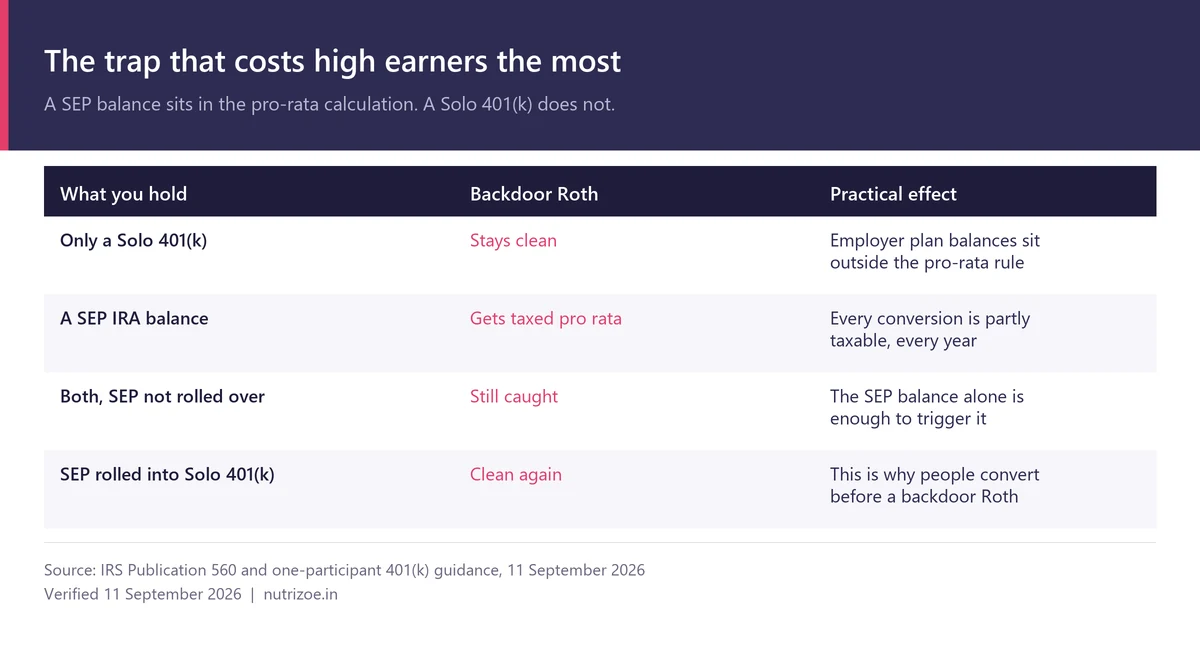
High-earning freelancers and the best account for high income freelancers discussion inevitably arrives here. The Backdoor Roth IRA is a strategy that allows anyone, regardless of income, to contribute $7,000 to a Roth IRA annually by first making a non-deductible traditional IRA contribution and then converting it. The problem is the Pro-Rata Rule.
The IRS requires you to calculate the taxable portion of any IRA conversion by looking at the ratio of pre-tax to after-tax money across all your traditional IRA accounts. If you have $100,000 pre-tax in a SEP IRA and convert $7,000, roughly 93% of that conversion is taxable, destroying the efficiency of the Backdoor Roth entirely.
Converting a SEP IRA to a Solo 401(k) for tax-free savings
The solution is direct: converting SEP IRA to Solo 401(k) in 2026. A Solo 401(k) is a qualified plan, not an IRA. It's generally excluded from the Pro-Rata calculation entirely. By rolling your pre-tax SEP IRA balance into a Solo 401(k), you clear the IRA slate and execute clean, tax-free Backdoor Roth conversions of $7,000 per year without the Pro-Rata penalty.
This single move, converting SEP IRA to Solo 401(k) in 2026, can be worth tens of thousands of dollars in tax-free retirement income over a 20-year horizon.
Consolidating legacy accounts into a high-powered wealth engine
Converting also creates an opportunity to consolidate scattered rollover IRAs, old employer 401(k)s, and legacy SEP accounts into one high-powered plan. A Solo 401(k) can accept rollovers from traditional IRAs, SEP IRAs, SIMPLE IRAs (after two years), and previous employer 401(k)s. Consolidation simplifies your financial picture and removes Pro-Rata exposure permanently.
Individual 401(k) for small business owners: your top questions answered
(Technical) Can I contribute to both plans in the same tax year?
Yes, but with a critical caveat. It's possible to have both a SEP IRA and a Solo 401(k). However, total contributions to both are aggregated and can't exceed $72,000 in 2026. The individual 401(k) for small business owners who runs both plans simultaneously doesn't get two separate $72,000 limits. The IRS treats them as a combined ceiling.
(Technical) Which plan is better if I plan to hire W-2 employees in 2027?
Once you hire a full-time employee other than your spouse, the Solo 401(k) is no longer a compliant plan. You would need to either terminate the plan and roll the assets into an IRA or another qualified plan, or convert it to a standard 401(k) that covers your new employee.
If employee hiring is on your 2027 horizon, the SEP IRA self-employed pension plan is structurally safer. It accommodates employees natively, every eligible employee must receive the same contribution percentage, but you don't need to terminate the plan. For anyone building toward a larger business, this is a legitimate SEP IRA advantage in the retirement plan comparison.
(Technical) How does the SECURE Act 2.0 impact "Roth SEP" availability?
SECURE 2.0 technically authorized Roth SEP contributions. In theory, this closes the Roth gap between the two. In practice, most major custodians, Fidelity, Vanguard, Schwab, have been slow to implement the Roth SEP option. Check directly with your provider before assuming this feature is available. As of 2026, the Solo 401(k) Roth sub-account remains far more reliably accessible for high earners subject to the mandatory Roth catch-up requirement under SECURE 2.0 Section 603.
The high-earner decision matrix
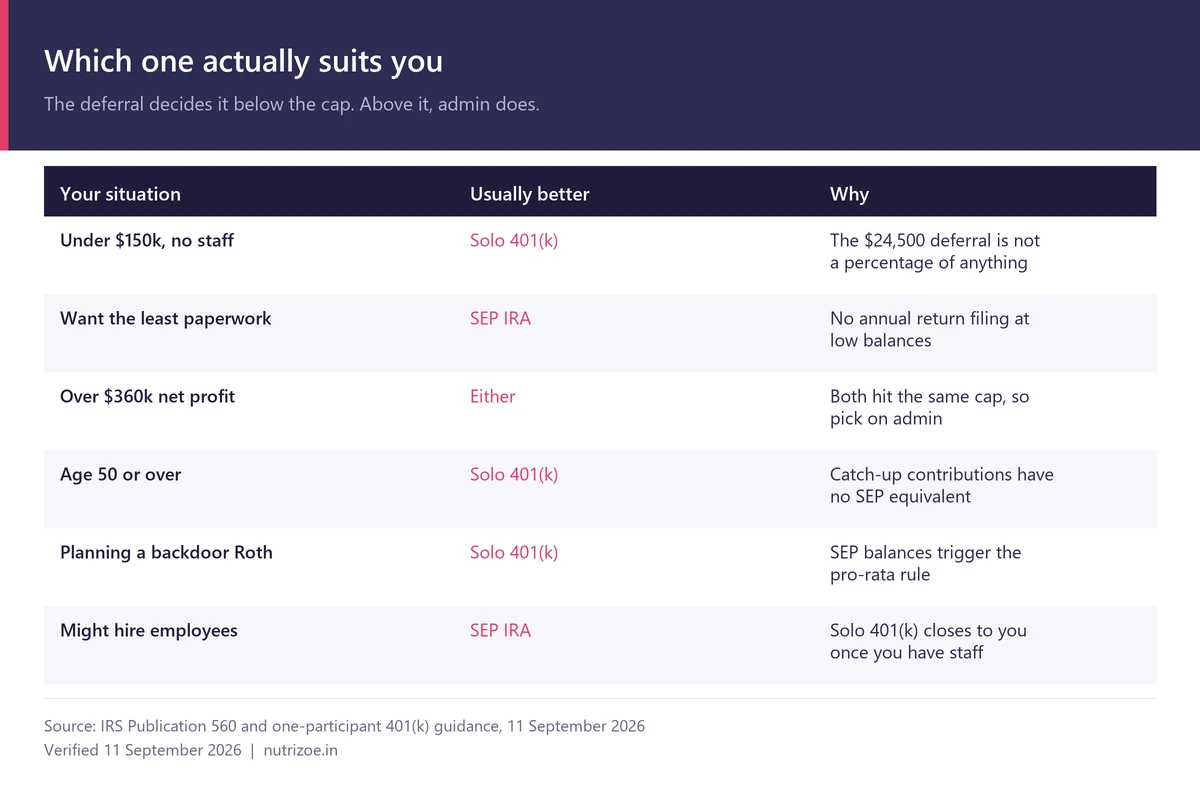
| Factor | SEP IRA | Solo 401(k) | Best Choice |
|---|---|---|---|
| Income under $280,000 | Lower limit | Higher limit by $24,500+ | Solo 401(k) |
| Age 50+ catch-up | Not available | $8,000 to $11,250 | Solo 401(k) |
| Roth option availability | Limited in 2026 | Widely supported | Solo 401(k) |
| Participant loan | Not available | Up to $50,000 | Solo 401(k) |
| Backdoor Roth compatibility | Destroys Pro-Rata | Preserves Pro-Rata clean | Solo 401(k) |
| Administrative burden | Zero | Form 5500-EZ over $250k | SEP IRA |
| Setup after December 31 | Available until tax deadline | Must open by Dec 31 | SEP IRA |
| S-Corp compatibility | Yes | Yes | Tie |
| Plan to hire employees | No disruption | Must terminate plan | SEP IRA |
| Self-employed pension simplicity | Maximum simplicity | Moderate admin | SEP IRA |
Final verdict: choosing between them in 2026
The decision comes down to one question: do you value simplicity above savings, or savings above simplicity?
If you earn under $280,000, are over 50, want Roth flexibility, or plan to use a Backdoor Roth strategy, the Solo 401(k) wins this retirement plan comparison at every turn. The individual 401(k) for small business owners operating solo is the most powerful tax-shielding tool available to a self-employed worker in 2026.
If you plan to hire employees soon, missed the December 31 deadline, or genuinely need zero administrative overhead, the SEP IRA self-employed pension plan is still a powerful, legitimate choice. Just know exactly what you're trading away.
The worst outcome here is choosing neither and letting another year of contributions go unshielded.
Where these figures come from
The SEP IRA contribution limits for 2026, and every other figure on this page, were read from the IRS on 11 September 2026 rather than from another article. If a number here stops matching the source, that's a correction worth sending.
SEP IRA contribution limits in 2026 share the same annual additions ceiling as a Solo 401(k), and those ceilings come from the IRS page on 401(k) and profit-sharing limits. The rules for a one-person plan are set out in the IRS guidance on one-participant 401(k) plans, and the worksheet that turns net profit into a contribution figure sits in Publication 560. The earned income those rates apply to is net profit less half your self-employment tax, which the SE tax calculator works out for you. That worksheet is the reason the headline 25% employer rate resolves to 20% of earned income for a sole proprietor, and it's what sets the SEP IRA contribution limits for 2026 in practice.