
Reviewed 11 September 2026. Figures on this page were checked against eCFR and IRS.gov on that date. Contribution limits and thresholds change every year, so if a number here no longer matches its source, tell me and it gets corrected.
A former colleague messages you about a weekend project. Good money, three weeks, entirely remote. You have the skills and the time.
Then the thought arrives. Am I allowed to take freelance work on an H-1B visa at all? So you search for an answer, and you get forum threads from 2019 contradicting each other, plus a dozen law firm pages that all end in a contact form.
Here is what I can tell you honestly. I’m Aradhana Sharma, a financial consultant, and I’m not an immigration attorney. What follows is the text of the regulation, the tax consequences if the work is authorised, and a clear line showing where you need somebody with a licence I don’t hold.
What the regulation actually says
Start with the source rather than a forum. The federal rule governing H-1B classification is 8 CFR 214.2(h), and one sentence in it shapes everything people argue about.
“A United States employer seeking to classify an alien as an H-1B, H-2A, H-2B, or H-3 temporary employee must file a petition on the form prescribed by USCIS in accordance with the form instructions.”
8 CFR 214.2(h), retrieved 11 September 2026
Read who acts in that sentence, and sit with it. The employer files. The classification exists because a specific company petitioned for a specific role. Your status is tied to that petition, which is why being self-employed on an H-1B runs into trouble immediately. There’s no petitioning employer in that arrangement unless one is deliberately constructed, and constructing one is legal work.
That’s as far as I will go on the law. Whether your particular situation is permitted depends on your petition, your employer, the nature of the work, and case law I’m not qualified to interpret. Anyone telling you a flat yes or no on a blog, mine included, is guessing.
Why that’s the wrong first question
Because it collapses several different situations into one word.
Freelancing on an H-1B visa can mean unpaid open source contributions. Or passive rental income. Or a paid project for a company that isn’t their sponsor. Or starting a company. These sit in genuinely different places, and the answer changes with each.
Ask your question with the specifics attached instead. Who is paying, for what, how much, and does the work resemble the role on your petition. An attorney can answer that in one consultation. Nobody can answer it in the abstract, which is exactly why the forum threads contradict each other.
Can H1B work on 1099, and what that form implies
A 1099 is a tax document. The IRS forms guidance for independent contractors is explicit that Form 1099-NEC isn’t used for wages paid to employees, which are reported on a W-2 instead. It reports payments to someone who isn’t an employee, which is the whole point and also the problem.
People usually hope the form is a technicality. It’s closer to a declaration. Accepting 1099 income says, in writing and to a federal agency, that you performed work for a party who wasn’t treating you as their employee. Set that alongside the sentence from the regulation above and you can see why this lands in an attorney’s inbox rather than an accountant’s.
There’s a second consequence people miss entirely, and it’s expensive.
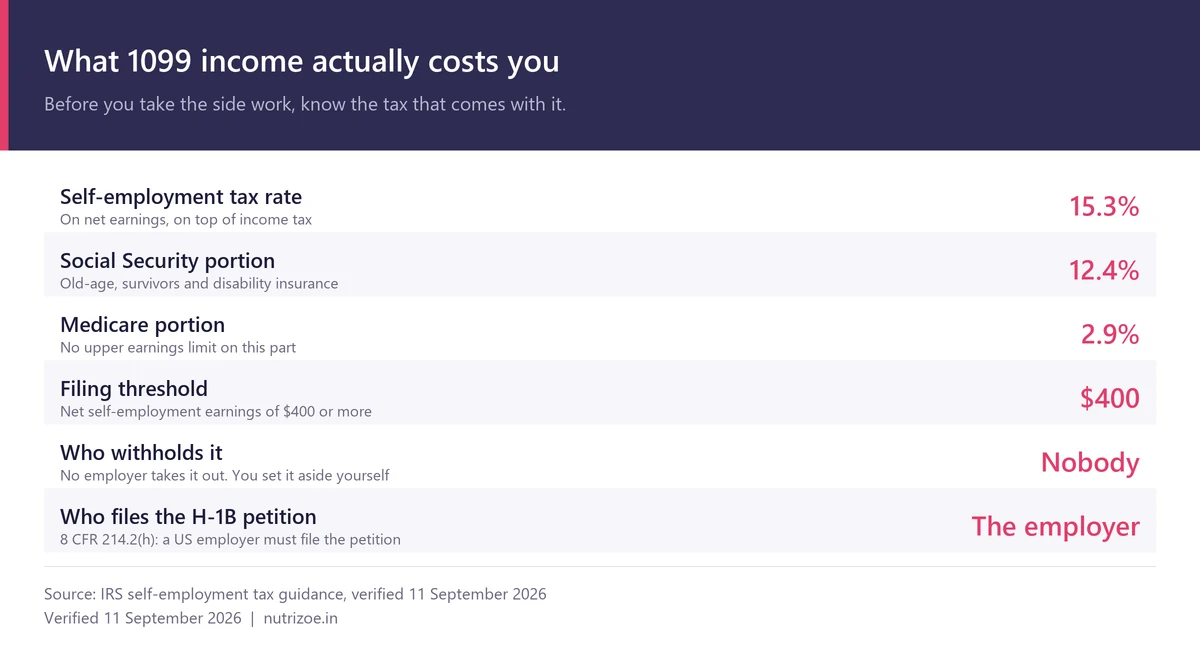
On W-2 income your employer pays half of Social Security and Medicare. On 1099 income you pay both halves, which the IRS puts at 15.3%, split as 12.4% for Social Security and 2.9% for Medicare. It applies once your net self-employment earnings reach $400.
So a $6,000 project isn’t $6,000. Before income tax, roughly $918 of it belongs to self-employment tax, and nobody withholds it for you. Run your own numbers before you accept the work. That surprise is the most common reason a first side project ends badly, and the fix is arithmetic rather than luck. The bookkeeping tools breakdown covers keeping track of it as it accrues.
Can H1B work part time for the sponsoring employer?
This one is genuinely different from the others, and people conflate it constantly.
Part-time hours for your own sponsor is a question about the terms of an existing petition rather than about freelancing on an H-1B for somebody else. Petitions specify employment terms, and changing them can require action from the employer. That’s a conversation with your employer’s immigration counsel, and it usually has a clean answer because somebody has the paperwork in front of them.
Freelancing on an H-1B for somebody else is where it gets tangled, and the second job belonging to a different company is exactly that case. At that point you’re back at the sentence from 8 CFR 214.2(h), and back to needing an attorney.
Can I do business on H1B, meaning starting a company?
Owning a company and working for one are separate acts, and that distinction is where most of the nuance lives.
People conflate the two constantly, and it’s the most common confusion in the whole self-employed on an H-1B discussion. Holding shares in a company is one question. Performing services for that company is another, and it’s the one that touches your status. Passive investment sits in a different place from active operation, and the boundary between them is exactly the kind of thing attorneys argue about.
If starting something is a live question for you, it’s worth a proper consultation rather than a search. The downside of getting it wrong reaches your status, not just your tax return, and status problems are far harder to unwind than tax ones.
Who on a US visa can do this without the argument
Plenty of the readers here aren’t on an H-1B at all, and for them the calculation is different.
Whether you’re a resident for tax purposes is a separate test again, decided by the IRS substantial presence test rather than by your visa, and you can check your own count before assuming. Green card holders and citizens have no work-authorisation constraint on self-employment. Holders of an employment authorisation document occupy a middle position that depends on the category the document was issued under. Students have their own rules entirely. In every one of these cases the specifics matter more than the label, so confirm yours rather than reasoning by analogy from a friend’s situation.
Once the work is authorised, the money side opens up considerably. A self-employed person can open a SEP IRA or a Solo 401(k), which changes the tax picture meaningfully, and the deductions available soften that 15.3% considerably. If you also hold a workplace plan, the guide on employer plans covers how the two interact.
The reporting trap on the other side
One thing that catches Indian professionals specifically. If you take side income and route any of it to an account in India, you may have created a reporting obligation that has nothing to do with your visa.
Foreign accounts crossing $10,000 in aggregate at any point in the year trigger a separate filing with FinCEN, covered in full in the FBAR guide. People think about the visa question and the tax question, then miss the third one entirely.
If the work is authorised, here is what the IRS wants
Suppose you cleared the status question properly and the answer was yes. The tax side has its own timetable, and it doesn’t wait for April.
The IRS position on estimated taxes is that sole proprietors generally have to make estimated payments if they expect to owe $1,000 or more when the return is filed. The year is divided into four payment periods. Nobody sends you a reminder.
There’s a safe harbour worth knowing, because it removes most of the anxiety. The IRS states you generally avoid the underpayment penalty if you owe less than $1,000 after withholdings and credits, or if you paid at least 90% of the current year’s tax, or 100% of the tax shown on the prior year’s return. That last one is the useful one: match last year’s total and you’re usually covered even if this year turns out bigger.
Income that arrives unevenly gets a concession too. The IRS notes you may be able to lower the penalty by annualising your income and making unequal payments, which fits side work far better than four identical instalments do.
Setting the money aside before you spend it
The mechanical fix is dull and it works. Move a percentage of every payment into a separate account the day it lands, and treat that account as money that was never yours. A separate bank, if you have the discipline problem most of us have, so it takes two days to get at rather than two taps.
What percentage depends on your bracket, and 30% is a common starting point that covers the 15.3% self-employment tax plus a reasonable slice of income tax. The calculator gives you the SE portion exactly, so you are only estimating the income tax half. Adjust once you have a real return to look at. The point is having the habit before the first invoice, because catching up later means paying from money you’ve already mentally allocated elsewhere.
Deductions genuinely change this arithmetic. Legitimate business expenses reduce net earnings, and net earnings are what the 15.3% applies to. The planning walkthrough covers what qualifies, and a retirement contribution can do double duty here, which is why the Solo 401(k) walkthrough matters more for self-employed people than it does for anyone on a payroll.
Keep the records as you go rather than reconstructing them in March. Most people weighing up freelance work on an H-1B visa are months away from needing this, and the ones who set it up early never have a bad April.
The three questions in the right order
Most people ask these backwards, which is why they get stuck. Somebody works out the tax first, decides the project is worth doing, takes the money, and only then wonders about the status question. By that point the options have narrowed considerably and the honest advice becomes damage control rather than planning.
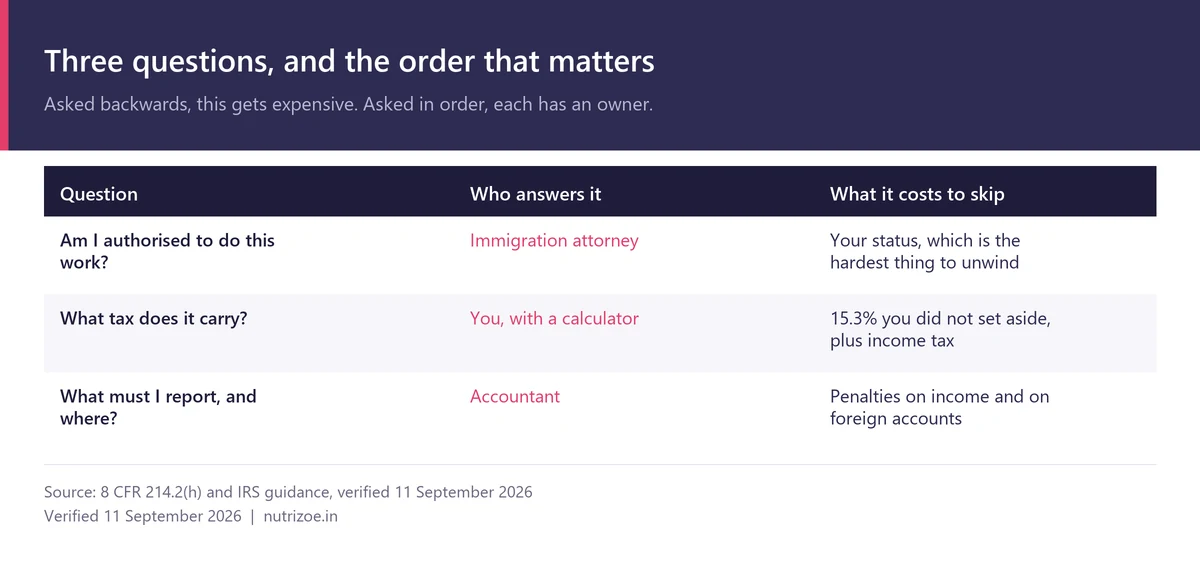
First, am I authorised? This is the immigration question and it comes before everything. Whether you can take that particular project is a matter for an attorney looking at your petition. Nothing below matters until this is settled.
Second, what does it cost? The 15.3% plus income tax, less deductions. This is arithmetic and you can do it yourself. Whether a part-time arrangement makes financial sense usually turns on this number rather than the headline rate you were quoted.
Third, what do I have to report? The income, and separately the accounts if any of it lands abroad. People who settle the first question with a lawyer still miss this one constantly.
Get them in that order and each one has a clear owner: an attorney, a calculator, and an accountant. Take them out of order and you end up asking a forum about a project you’ve already been paid for.
Questions people ask
Does it change anything if the work is unpaid?
Compensation is one factor among several, and removing it doesn’t automatically resolve the question. Volunteering in a role a company would normally pay for raises its own issues. Ask an attorney about your specific arrangement.
Does it help if the client is outside the US?
People assume a foreign client sidesteps the issue. Where you perform the work matters, not only where the payer sits. This is a common misconception and a poor one to rely on.
What if the invoice goes through my spouse’s business?
Freelancing on an H-1B through somebody else’s invoice doesn’t change who performed the work. Restructuring the invoice doesn’t answer the underlying question.
What happens to the tax if the work turns out to be unauthorised?
The IRS and USCIS are separate agencies with separate concerns. Income remains reportable regardless, which is why people sometimes find themselves reporting income from work that created a status problem. Get advice before, not after.
Could I take 1099 income from my own sponsor instead of W-2?
That inverts the employment relationship the petition rests on. Whatever the appeal, it’s a question for the employer’s immigration counsel.
What if the business makes no money?
Profit isn’t the test. Being self-employed on an H-1B turns on whether you performed services, so the activity decides it rather than the outcome. A loss-making venture can still create the same issue as a profitable one.
Does my employer need to know?
Many employment contracts contain outside-activity clauses independent of any immigration question. Even where the law permits something, your contract may not, and the two get discovered together at the worst moment.
How long does an attorney consultation usually take?
An hour is typical for a question this shape, and going in with the details written down makes it shorter. Bring the petition, a description of the proposed work, and who is paying.
I’m on an EAD. Do these constraints apply to me?
Employment authorisation documents are issued under different categories with different conditions. Some permit self-employment comfortably, which puts you in a very different position from someone weighing freelance work on an H-1B visa. Check which category yours falls under rather than assuming.
Is passive income treated the same as freelance work?
Generally treated differently, because it doesn’t involve performing services. Rental income and dividends sit apart from active work, though the reporting obligations still apply.
Why this page won’t just tell you yes
Because the cost of a wrong answer here isn’t a tax bill. It reaches your status, and status problems follow people for years, through renewals, through green card applications, through questions at the border that nobody enjoys answering.
Plenty of pages will hand you a confident yes or no on whether you can be self-employed on an H-1B. Some of them are written by firms that would like you to call. Others are written by people summarising a forum thread they half remember. Neither has seen your petition.
What I can do usefully is narrow the ground. The regulation says the employer files the petition. Self-employment tax runs at 15.3% on net earnings from $400. Estimated payments start mattering at $1,000 of expected tax. Those three facts are checkable, sourced above, and they hold regardless of what your attorney concludes about the first question.
What one consultation buys you
An hour with an immigration attorney costs less than most people expect, and far less than a status problem. It’s the only reliable way to settle whether freelance work on an H-1B visa is open to you. Go in with the specifics written down: who pays, for what work, over what period, and how it compares to your petitioned role. Bring the petition itself if you have a copy, because the answer often turns on wording nobody remembers accurately from memory.
You will leave with an answer that applies to you rather than to a stranger on a forum in 2019. That’s the whole reason this page refuses to give you one. Anyone who answers this without seeing your petition is selling confidence rather than accuracy.
Nothing here is legal or tax advice, and the sourcing rules explain why immigration questions get handled this way. The limits of what this site can tell you are in the about page and the disclaimer. If a figure here has moved, tell me through the contact page.