
Reviewed 11 September 2026. Figures on this page were checked against IRS.gov on that date. Contribution limits and thresholds change every year, so if a number here no longer matches its source, tell me and it gets corrected.
The question underneath almost every 401(k) thread on an Indian immigrant forum is the same one: what happens to this money if I go back?
That fear is why a lot of people skip the match entirely, which is the single most expensive mistake in this whole area. This page covers 401k for h1b visa holders from the specific angle nobody writes for: someone who might spend 6 years here, or 30, and doesn’t yet know which.
Written by Aradhana Sharma. Every figure below comes from IRS.gov and carries the date it was checked. I’m not a CPA, a tax attorney, or an immigration lawyer, and the editorial policy sets out exactly where that line sits.
The short answers first
If you only read one section, read this one. Each answer is expanded further down.
Can you contribute to a 401(k) on an H-1B? Yes. Your plan’s rules decide, not your visa.
Is a 401(k) worth it on an H-1B? The match, always. The rest depends on whether you value deferral or liquidity more.
Should you invest above the match? Only after you have a cash buffer. Then usually yes.
Can you withdraw early? Yes. It costs income tax plus a 10% additional tax, so it’s rarely the right move.
What if you leave the US? Nothing forces you to act. The account stays yours from anywhere in the world.
Those five cover most of what people want to know about a 401(k) on an H-1B. The detail underneath is where the money actually sits, so keep reading if any of it applies to you.
Can H1B contribute to 401k at all?
Yes. Eligibility for an employer plan runs off your employment and the plan’s own rules, not your immigration category. If your employer offers a plan and you meet its service requirements, you’re in.
People still ask, because the visa touches so much else, from where you can work to whether you can change jobs. Retirement plan participation is one of the few areas where it mostly doesn’t intrude. Your plan document governs, so read it, and if the answer there’s unclear ask your plan administrator in writing rather than asking a forum.
So the short answer is yes, and there’s a longer one behind it. What the visa does affect is your tax residency, which changes how distributions are taxed later. The IRS defines a nonresident alien as someone who hasn’t passed either the green card test or the substantial presence test. That test counts all your days present this year, plus one third of last year’s days, plus one sixth of the year before, and the calculator here does the arithmetic. Most people on a work visa pass it and file as residents, which is the assumption running through the rest of this page.
Is 401k worth it for H1B when you might leave?
Start with the match, because it settles most of the argument. An employer match is compensation you’ve already earned and are declining to collect. Nothing about a temporary visa changes that.
Beyond the match, the question has one real variable: what you would do with the money instead. If the alternative is a taxable brokerage account, the 401(k) still wins on deferral. If the alternative is remitting to India for a property purchase, that’s a different conversation about liquidity and currency, and reasonable people land in different places.
The 2026 ceilings matter for anyone earning well. Total annual additions across employee and employer contributions cap at $72,000, and the compensation counted toward your contribution stops at $360,000, per the IRS retirement plan limits. Those numbers are laid out with the rest of the 2026 caps on the main guide.
H1B leaving US 401k: your four options
Most people confront this in the last fortnight before a flight, which is exactly when they get it wrong. The decision doesn’t expire when your visa does, and that’s the most useful thing to know.
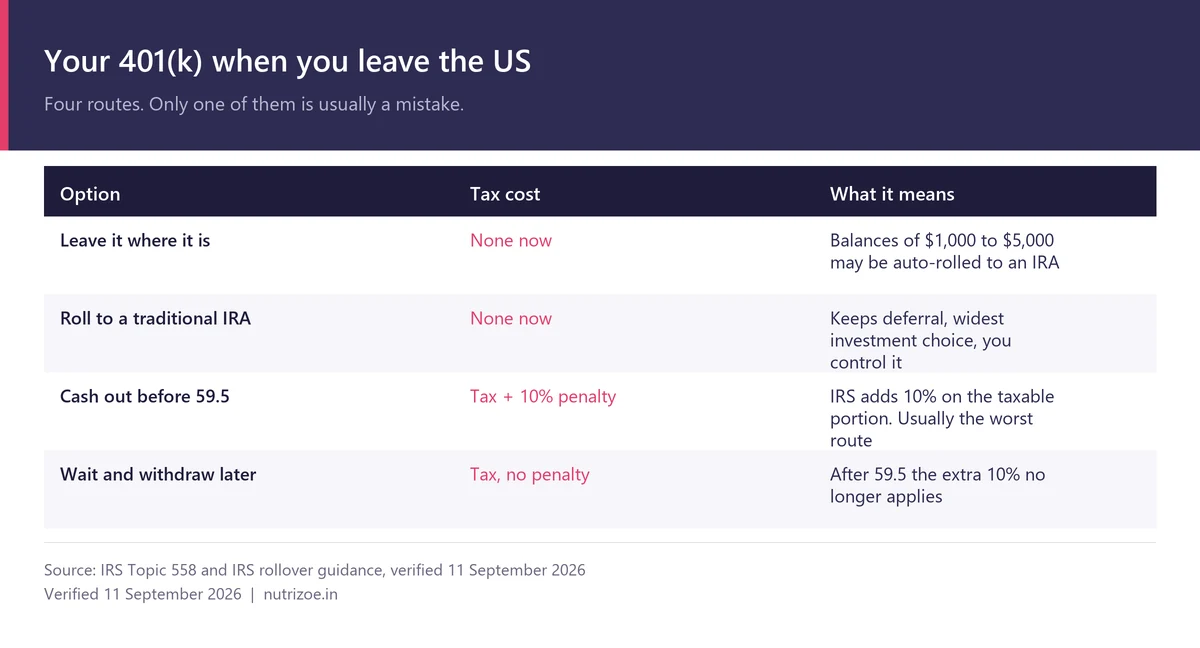
The account doesn’t care which country you live in, and the full checklist for a return to India covers what else needs deciding before you fly. It sits there, invested, until you touch it. Leaving the US triggers no distribution and creates no deadline. That’s the most reassuring thing about holding a 401(k) on an H-1B, and almost nobody says it out loud.
One detail catches people out. If you leave an employer with a smaller balance, the plan can move it for you: IRS guidance says an account between $1,000 and $5,000 may be deposited into an IRA in your name if you neither elect payment nor roll it over yourself. That isn’t a penalty, though it does mean the money can end up somewhere you didn’t choose, which is an argument for handling the rollover deliberately before you fly.
Can H1B withdraw 401k early, and what it costs
Yes, and it’s usually the worst of the four routes. The real question underneath is whether leaving the country counts as a special case that avoids the penalty. It doesn’t. An early 401(k) withdrawal on an H-1B is treated like any other.
IRS Topic 558 puts it plainly: the law imposes a 10% additional tax on certain early distributions, equal to 10% of the portion of the distribution that’s includible in gross income. That sits on top of ordinary income tax on the withdrawal. Departure from the United States isn’t on the list of exceptions.
So an h1b 401k withdrawal taken at 34 because you’re moving home costs you the tax, the 10%, and every year of compounding that money would have done between now and retirement. The third cost is the one nobody puts in the spreadsheet, and it’s the largest. Run your own numbers through the retirement target explainer before deciding.
After 59 and a half it changes. At that point the extra 10% no longer applies. The money is still taxable when it comes out, and how it’s taxed depends on your residency and on the treaty position between the United States and India, which is exactly the point to pay a cross-border professional rather than read a blog. The IRS publishes the India treaty documents if you want to see the primary text.
Should H1B invest in 401k or send money to India instead?
The honest answer is both, in an order. Take the full match first, because that’s free money with no equivalent anywhere. Then decide about the rest. How much you invest in the 401(k) beyond that point turns on your timeline rather than your visa stamp.
The question beyond the match is really about optionality. A 401(k) is locked until 59 and a half without penalty. Money sitting in an NRE account or an Indian mutual fund isn’t. If your plan is to return within 5 years and buy property, liquidity has real value and the deferral doesn’t fully compensate for losing it.
If you might stay, the math flips hard. Deferral over 25 years in a US account beats most alternatives, and the currency risk cuts both ways rather than only against you. Most people genuinely don’t know which case they’re in, which argues for taking the match, filling some deferral, and keeping a cash buffer rather than committing to either extreme.
The reporting obligation nobody mentions
If you’re a US tax resident and you still hold accounts in India, you likely have a filing requirement that has nothing to do with your 401(k) and much larger consequences for getting it wrong.
FinCEN requires an FBAR from anyone with a financial interest in or signature authority over foreign financial accounts where the aggregate value exceeds $10,000 at any time during the calendar year. Aggregate, and at any point, so a salary account, an old savings account and a fixed deposit that never individually reach $10,000 can still trigger it between them.
This is the single most common thing Indian professionals in the US miss, and the FBAR guide covers who it reaches and how to file it.
If you’re self-employed rather than on a work visa
Green card holders, citizens, and people working on an EAD have options a 401(k) at an employer doesn’t cover, because they can open a plan of their own.
The first decision there’s between a SEP IRA and a Solo 401(k), and the Solo wins more often than people expect. From there the branches are the Roth route, the HSA played as a retirement account, and for high earners with no staff, a solo defined benefit plan. The full sequence sits in the planning walkthrough, and the automation guide covers funding it on income that moves.
Work authorisation is immigration law, not tax, and it’s genuinely case-specific. The guide on side work and H1B status quotes the regulation and shows where an attorney becomes necessary, because I wouldn’t take a blog’s word for it including mine.
Questions people ask
Can I contribute to a 401(k) and an IRA in the same year?
Generally yes, though deducting the IRA contribution can be limited once you’re covered by a workplace plan and your income passes certain thresholds. The limits sit on the IRS site and move annually.
Does leaving the country count as a hardship for withdrawal purposes?
No. IRS Topic 558 lists the exceptions to the 10% additional tax, and relocating abroad is not among them. Cashing out on departure is taxed like any other early distribution.
What happens if my employer terminates the plan after I leave?
You will be given election options. If your balance is between $1,000 and $5,000 and you don’t respond, the administrator may roll it into an IRA in your name. A rollover isn’t a withdrawal, so that’s a separate matter from taking money out. Keep an Indian address on file that actually receives post.
What if the company match is small?
Take whatever match exists, then treat the rest as an ordinary investment decision against your other options. A 50% match on 3% of salary is still a 50% instant return on that portion.
Can I access the money from India once I move back?
Yes, and the rules don’t change once you’re back in India. The account stays yours and you can request distributions from abroad, subject to tax and, before 59 and a half, the additional 10%. How your new residency and the India treaty affect the tax is a question for a cross-border tax professional.
Is it worth it on a 3 year assignment?
The match, always. On a fixed short assignment the real question is liquidity, and a definite three year horizon is the strongest case for prioritising it, because you’ll likely want capital available on arrival back in India.
What to do this week
Check whether you’re capturing the full match. That’s a five minute job in your payroll portal, and it’s the highest return action available to anyone holding a 401(k) on an H-1B.
Then handle the h1b leaving us 401k question properly if a move is on the horizon, which means deciding on a rollover before you fly rather than after. After that, total up every Indian account you still hold, including ones you forgot about, and see whether the combined peak crossed $10,000 at any point last year. If it did, the FBAR question is live and worth a professional’s hour.
Nothing here is personalised financial, tax or immigration advice. The limits of what this site can tell you are set out in the about page and the disclaimer. If a figure here is out of date, tell me through the contact page and I will correct it and note the change.