


$10,000. That’s the failure-to-file penalty for Form 8938, and it’s a flat amount rather than a percentage of anything.
It can also be $0. The instructions carry a reasonable cause exception that most summaries mention in passing and never explain, and the gap between those two numbers is worth 20 minutes of reading.
I will say the quiet part first, because twelve years of filing in the States taught me to check it before anything else: these thresholds are high. Plenty of people reading this were never over them and owe nothing. Work that out before you spend an evening worrying.
So what if you forgot to file Form 8938 entirely? First, a question worth asking before you panic: were you ever over the threshold at all?
What is the threshold for Form 8938?
There isn’t one. There are eight, and which applies depends on where you live and how you file. That alone sends people to the wrong answer.
| Your situation | On the last day | At any time |
|---|---|---|
| In the US, unmarried | $50,000 | $75,000 |
| In the US, filing separately | $50,000 | $75,000 |
| In the US, filing jointly | $100,000 | $150,000 |
| Abroad, unmarried | $200,000 | $300,000 |
| Abroad, filing jointly | $400,000 | $600,000 |
You cross if you exceed either column. Instructions for Form 8938, read 11 September 2026.
Read the two columns as an or. A balance that peaked at $80,000 in June and sat at $20,000 on 31 December still puts an unmarried filer in the US over the line, because the second column caught it. People check their year-end statement, see a small number, and stop.
Were you over?
Enter two figures and this tells you which column catches you.
Covers specified foreign financial assets, which is broader than bank accounts. It’s a threshold check, not a filing decision, and it can’t see your return.
The Form 8938 failure to file penalty
Straight from the instructions: a Form 8938 late filing penalty of $10,000 if you don’t file a complete and correct form by the due date, extensions included.
Flat. Not scaled to the size of the account, which means a forgotten $60,000 fixed deposit and a forgotten $6 million portfolio start in the same place. The Form 8938 late filing penalty behaves nothing like an income tax penalty in that respect.
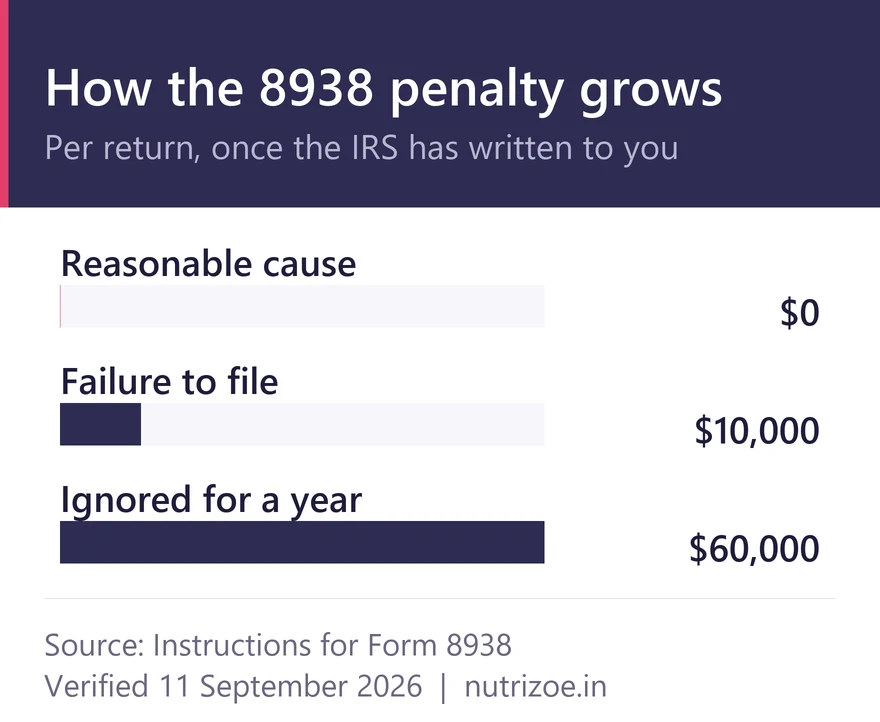
Where $10,000 turns into $60,000
The escalation clock doesn’t start at the filing deadline. It starts when the IRS writes to you.
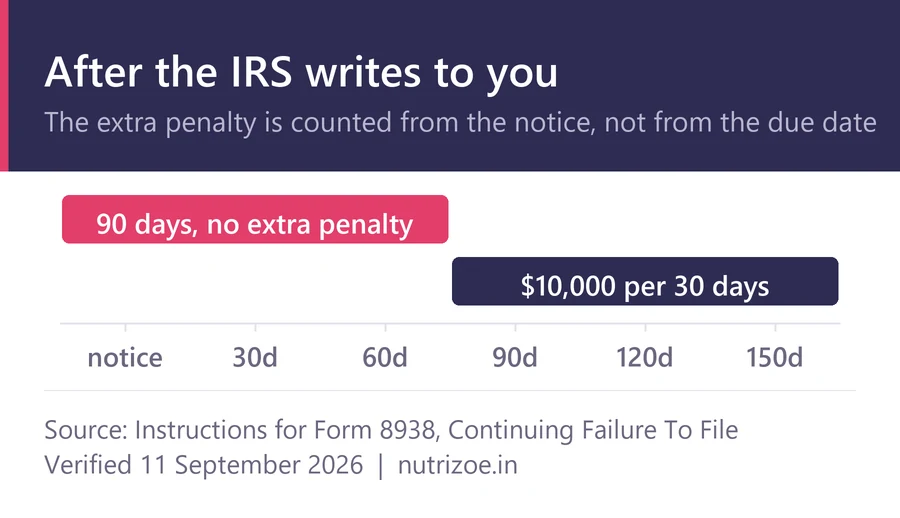
After the 90-day window closes, it’s an additional $10,000 for each 30-day period or part of one, capped at $50,000 extra. So $60,000 is the ceiling on a single return, and getting there takes the better part of a year of doing nothing after being told.
Which is the encouraging part. Nobody arrives at the cap by accident. If a notice has landed, answering it inside 90 days keeps you at the base figure, and that’s a deadline worth writing on a wall.
Form 8938 penalty relief if you forgot to file
The instructions are unusually plain here:
No penalty will be imposed if you fail to file Form 8938 or to disclose one or more specified foreign financial assets on Form 8938 and the failure is due to reasonable cause and not to willful neglect. You must affirmatively show the facts that support a reasonable cause claim.
Instructions for Form 8938
That’s the answer for anyone wondering what to do if they forgot to file Form 8938 and the year has already closed. Read the last sentence twice. Affirmatively show. Silence isn’t a defence, and neither is “I didn’t know”, on its own. You write the statement, you attach the facts, you make the case.
One thing that specifically doesn’t count: the instructions say a foreign jurisdiction’s own penalties for disclosure are not reasonable cause. That closes off an argument people reach for with Indian accounts, and it’s better to know now than in a letter.
So can you file Form 8938 late? Yes. It attaches to an amended return for the year it belongs to, and filing it before anyone contacts you is the version of this with the fewest moving parts.
Do I need to file Form 8938 and FBAR both?
Often, yes, and filing one does nothing for the other. They go to different agencies, on different systems, with different thresholds. FinCEN runs the FBAR; the IRS runs 8938.
The FBAR goes to FinCEN when your foreign accounts together top $10,000 at any point. Form 8938 goes to the IRS with your return at the much higher figures in the table above. An NRI with a salary account, an old savings account and one fixed deposit can clear the FBAR line easily while staying well under 8938, which is why the FBAR page gets more traffic than this one deserves to.
The IRS keeps a side-by-side comparison of the two, and it’s the page to trust over any blog summary, this one included. If you’ve missed both, deal with the late FBAR in the same sitting, because the reasoning you write for one is most of the reasoning for the other.
And check which years you were even a US person for tax purposes before filing anything. Students in their first 5 calendar years usually aren’t, which takes whole years off the table. The substantial presence test calculator settles it, and if you crossed mid-way there’s a separate mess about which return you filed worth checking at the same time.
Where this stops being a form
One missed year, assets you already declared income on, and no letter from anyone: that’s an amended return and a written statement. Several years, or income that never made it onto a return, and you’re in streamlined filing compliance procedures, which needs a cross-border tax professional rather than a weekend.
Written by Aradhana Sharma. She spent twelve years living and working in the United States and moved back to India in 2019, so she has filed on both sides of this and from both directions. She advises small-scale businesses, has been self-employed for nine years and teaches business and finance on Udemy. She is not a CPA, an enrolled agent or an attorney. Every threshold and penalty on this page was read from the Instructions for Form 8938 on 11 September 2026. They change, so if a number here stops matching its source the contact page is how it gets fixed, under the editorial policy. A multi-year case belongs with a cross-border professional.