


Nearly every guide tells nonresidents they lose the standard deduction. For Indian students, that’s wrong.
Start there, because it changes the maths on everything below. Here’s IRS Publication 519, the nonresident’s own manual:
My last American return was a dual-status one, filed the year I moved home to India. Working out which form covered which half of that year took longer than the return itself, and the treaty article below is the single most useful thing I have ever found in Publication 519 for Indian readers.
Nonresident aliens cannot claim the standard deduction. However, there is a special rule, described next, for certain nonresident aliens from India.
IRS Publication 519, chapter 5
The rule underneath names Article 21(2) of the United States-India Income Tax Treaty, and it’s the reason the IRS prints a worksheet called Standard Deduction Worksheet for Students and Business Apprentices From India. A whole worksheet, for one country.
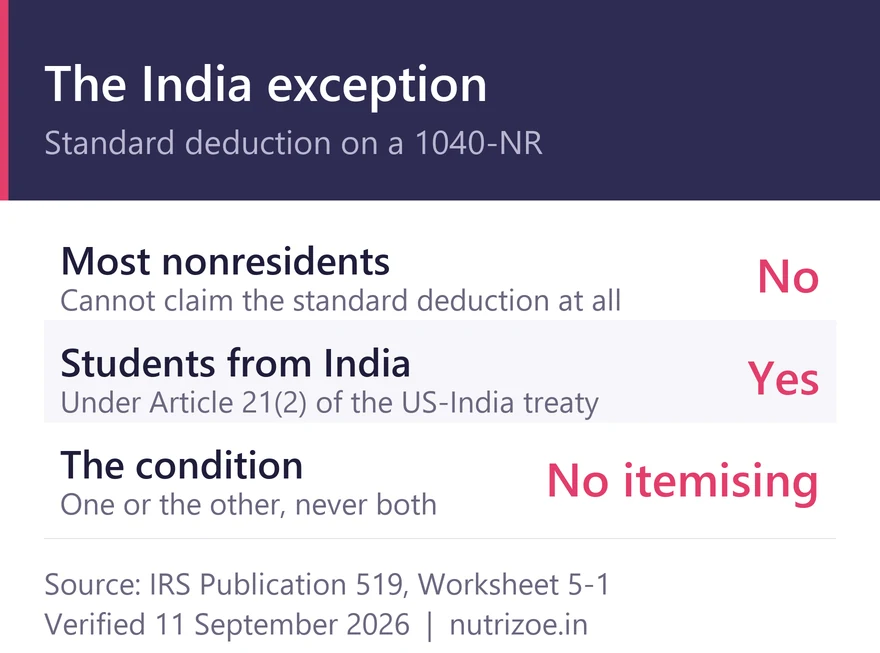
So when people ask whether a 1040NR has a standard deduction, the honest answer is: not usually, and yes for you. It applies to students and business apprentices, not to every Indian national on every visa, and Pub 519 adds one trap. Married, with a spouse who files and itemises? Then you can’t take it.
What happens if you file a 1040 instead of a 1040NR
The return gets processed. That’s the problem.
Nothing bounces, no letter arrives, and the refund often lands larger than it should. A resident return opens up credits a nonresident was never entitled to, and software that never asked about your visa will happily apply them. Two years later a bank or an immigration lawyer asks for your filing history and the mismatch surfaces.
What it costs depends on which way the error ran. Overclaimed credits mean you owe money back, with interest from the original due date. And a 1040NR late filing penalty can stack on top where the correct return was never filed at all, because the IRS treats the wrong form as a return that doesn’t count.
| On the return | Form 1040 (resident) | Form 1040-NR |
|---|---|---|
| Income taxed | Worldwide | US-source only |
| Standard deduction | Yes | No, unless Article 21(2) applies to you |
| FICA on wages | Owed | Exempt in your first 5 calendar years |
| Form 8843 | Not used | Filed alongside, even with no income |
| Foreign accounts | FBAR and 8938 in range | Generally out of range |
IRS Publication 519 and the Instructions for Form 1040-NR, read 11 September 2026.
Do I need to file a 1040NR at all?
It turns on whether you pass the substantial presence test for that year.
Days in the US get counted on a weighted formula, and days you were an exempt individual don’t count at all. F-1 students are exempt for 5 calendar years, which is why a student can spend four straight years here and still file as a nonresident. Run the substantial presence test calculator for each year separately before you decide anything. Year by year, because the answer changes.
The year you cross is its own creature. Arrive or leave mid-year and you’re dual-status, filing part of the year each way, which is the same knot the checklist for moving back to India untangles from the departure end.
Fixing it: the 1040NR amended return
You don’t file a second original return. You file Form 1040-X over the top, with the correct 1040-NR attached behind it.
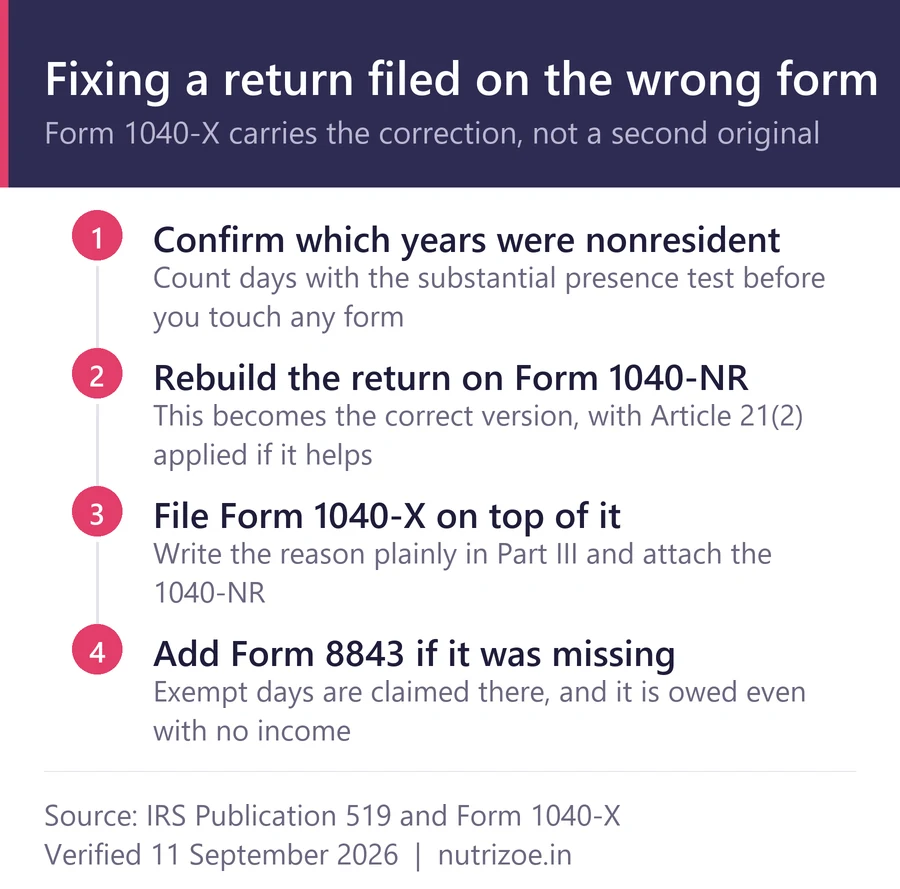
What to do if you filed a 1040 instead of a 1040NR is mostly this: say what happened without dressing it up. “I filed Form 1040 for 2024. I was a nonresident alien under the substantial presence test that year and should have filed Form 1040-NR.” That’s the whole explanation. The person reading it processes hundreds a week.
The deadline is the general refund window: 3 years from the date you filed, or 2 years from the date you paid, whichever falls later. If the correction means you owe, pay when you file rather than waiting for a bill, because interest runs either way.
Before the envelope goes
Ticks are saved in this browser, so you can come back to it.
Do I need to file 8843 with a 1040NR?
Yes, and you owe it for years with no income at all. Form 8843 is how you claim the exempt days that keep you nonresident, so skipping it quietly weakens the position the rest of your return depends on.
Plenty of students file three or four years of it late in one go, which is allowed and unremarkable. One form per year, signed, posted together. The IRS page for Form 8843 lists who owes it.
The reverse mistake, which is more expensive
Filing a 1040-NR when you’d already become a resident costs more, because residents get credits and deductions that nonresidents don’t. People overpay for years this way and never find out. The Form 1040-NR page sets out who it is for.
The tell is the 5-year mark on F-1. Once you’re past it and meeting the presence test, you file as a resident, FICA becomes properly due on your wages, and the foreign accounts you still hold in India come into range for FBAR reporting. Missing that is fixable, and worth catching in the same sitting.
While you have the W-2 out, check boxes 4 and 6. If you were on OPT and there are numbers in them, that money is claimable too, and the same 3-year clock applies.
Where I’d stop and pay someone
A single clean year, one W-2, no dependents, and you can do this yourself. Three or more years, a dual-status year, a spouse filing separately, or unreported income anywhere in it, and a cross-border accountant earns their fee on the first call. Treaty positions in particular are easy to claim and awkward to defend.
Written by Aradhana Sharma. She spent twelve years living and working in the United States and moved back to India in 2019, so she has filed on both sides of this and from both directions. She advises small-scale businesses, has been self-employed for nine years and teaches business and finance on Udemy. She is not a CPA, an enrolled agent or an attorney. Every rule here was read from IRS.gov on 11 September 2026 and the source is named next to the claim. Treaty positions are easy to claim and awkward to defend, which is why this page says where to stop. Corrections go through the contact page under the editorial policy.






Pingback: H4 EAD RFE response time: the 12-week rule explained
Pingback: Forgot to file Form 8938? Penalty, relief and what to do