


You file it late, right now, through the same system you’d have used on time. The IRS says so directly: if it hasn’t contacted you and you’re not under investigation, filing late as soon as possible keeps the penalty down. And if you already declared the income and had a decent reason for missing it, the published answer is no penalty at all.
That’s the whole answer. The rest of this page is the detail behind it, because “file it late” hides four questions that actually decide how much trouble you’re in.
I filed an FBAR for most of the twelve years I lived in the United States. The accounts that triggered it were the dullest things I owned, and that is the whole trap. Nothing about an old salary account in Delhi feels like something a foreign government would want to know about.
Written by Aradhana Sharma. She spent twelve years living and working in the United States and moved back to India in 2019, so she has filed on both sides of this and from both directions. She advises small-scale businesses, has been self-employed for nine years and teaches business and finance on Udemy. She is not a CPA, an enrolled agent or an attorney. Every figure on this page was read from IRS.gov, FinCEN, the eCFR and the US Code on 11 September 2026, and each one carries its source in the text. Where a case turns on facts this page cannot see, it says so instead of guessing.
What happens if you forgot to file an FBAR
Two things, in order. The missed report is a violation, and the violation may carry a penalty. Those are separate facts and people collapse them into one, which is where the panic comes from.
Here’s the IRS on the first part, from its FBAR page, last updated 30 July 2026:
If the IRS hasn’t contacted you about a late FBAR and you’re not under civil or criminal investigation by the IRS, you should file late FBARs as soon as possible to keep potential penalties to a minimum.
Read the conditions on a late FBAR. No contact, no investigation. If both hold, the door is open and the IRS is telling you to walk through it. Most people who discover a late FBAR a year or two on are firmly inside those conditions, which is worth knowing before you spend a weekend reading forum threads written by people who weren’t.
The second part is the one nobody quotes, and it comes from IRS Publication 5569, the FBAR reference guide the IRS writes for its own examiners:
If they properly report the foreign financial account on a late-filed FBAR, and the IRS determines the FBAR violation was due to reasonable cause, no penalty will be imposed.
No penalty will be imposed. That’s the IRS’s own guidance to the people who assess these penalties, and it sits on page 8 of a document almost nobody outside the profession opens.
Late FBAR: how many years back do you go?
This is the most-asked version of the question, and the answer sits in the statute. No IRS page carries it. 31 USC 5321(b)(1) sets the window the Treasury has to act in:
The Secretary of the Treasury may assess a civil penalty under subsection (a) at any time before the end of the 6-year period beginning on the date of the transaction with respect to which the penalty is assessed.
Six years. That’s the window people mean when they ask how many years back a delinquent FBAR goes. For a report you never filed, the period is generally counted from the date the FBAR was due, which puts a practical fence around how far back the exposure runs. Pinning the exact start date for a specific year is genuinely a professional’s job, so the tool below shows you the shape of it rather than pretending to give legal advice.
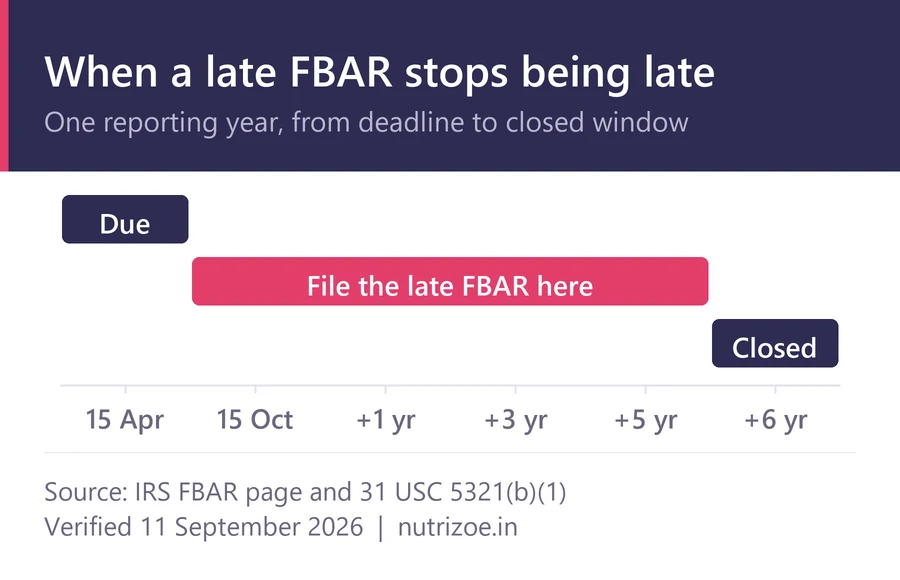
A year showing as closed doesn’t mean the late FBAR stops being owed. It means the clock on assessing a penalty for it has run. Those are different things, and the FBAR itself is still worth filing for a year that falls outside the window, because a clean record is what you want if any of the later years ever get looked at.
How to file a delinquent FBAR
Publication 5569 spells out the mechanics, and they’re less dramatic than the situation feels:
When a U.S. person learns they should have filed an FBAR for an earlier year, they should electronically file the late FBAR using the BSA E-Filing System. They can enter the calendar year reported, including past years, on the online FinCEN Form 114.
Same system, same form. A late FBAR just needs the year set to the one you missed. There’s no separate late form and no amnesty application to post off. If you’ve already filed a current-year report you know the system, and if you haven’t, the walkthrough on the main FBAR page covers the account-by-account part that takes the longest.
Then comes the part that decides the outcome. FinCEN’s late-filing instructions say a report filed after 15 October triggers a dropdown asking why, and if none of the listed reasons fit you pick “other” and write your own. Publication 5569 gives the size of that box: 750 characters.
750 characters is about 120 words, and it is the only explanation a late FBAR ever gets. That’s the entire space you get to explain yourself, and it’s the only place your reason for filing late gets recorded. Writing it carelessly is the single cheapest mistake available here. Draft it somewhere else, cut it to fit, and say plainly what happened: when you learned about the obligation, why you didn’t know, and that the income was reported.
What counts as reasonable cause for FBAR late filing?
The statute gives two conditions, and you need both. From 31 USC 5321(a)(5)(B)(ii):
No penalty shall be imposed under subparagraph (A) with respect to any violation if (I) such violation was due to reasonable cause, and (II) the amount of the transaction or the balance in the account at the time of the transaction was properly reported.
Condition two is the one people trip on. Reasonable cause on its own isn’t enough. The account balance has to have been properly reported as well, which in practice means the interest on that NRE or NRO account went onto your return and the Schedule B questions were answered honestly. Someone who declared everything and simply didn’t know FinCEN wanted a separate form is in a very different position from someone who kept the income off the return too.
The law leaves reasonable cause undefined, judged on facts instead, which cuts both ways: there’s no box you can fail to tick, and there’s no guarantee either. Genuinely not knowing the obligation existed is common among people who moved to the US as adults and kept accounts at home. Whether that reads as reasonable depends on how you tell it in those 750 characters.
The FBAR penalty for not filing, in actual numbers
The main FBAR page on this site declines to quote penalty figures, on the grounds that a wrong number would be worse than no number. That was the right call at the time and it’s a debt worth paying off, so here are the figures with their source.
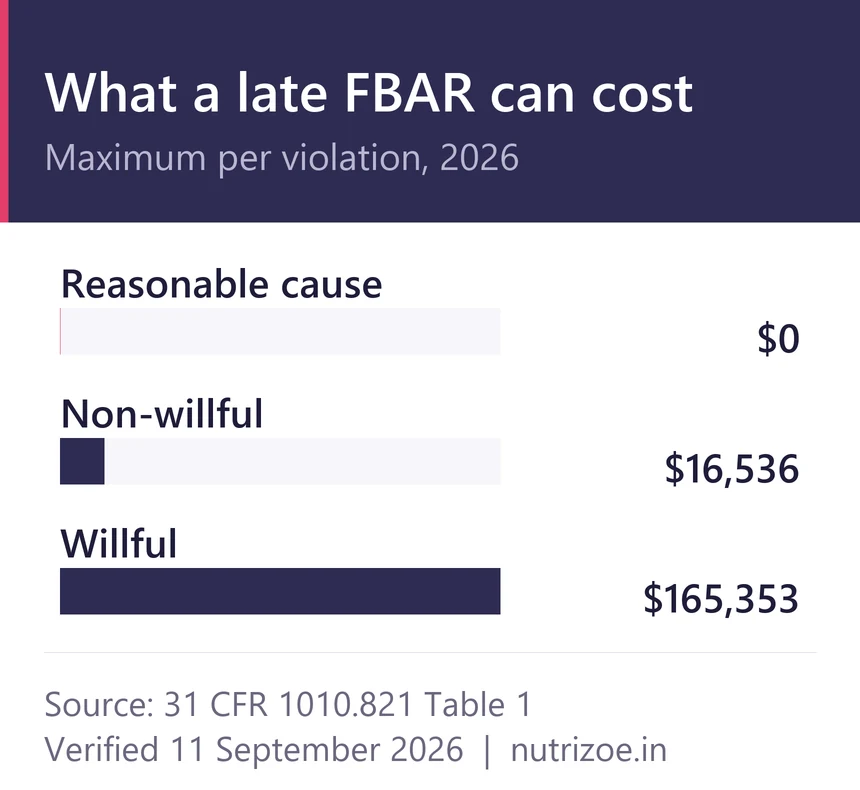
The IRS says the maximums are adjusted annually for inflation and points at Title 31. 31 CFR 1010.821, current as of 9 September 2026, holds the table.
| Violation | Maximum | Where it comes from |
|---|---|---|
| Reasonable cause | $0 | 31 USC 5321(a)(5)(B)(ii), if the account is also properly reported |
| Non-willful | $16,536 | 31 USC 5321(a)(5)(B)(i). Statute says $10,000, adjusted for inflation |
| Willful | $165,353 | Or 50% of the account balance, whichever is greater |
| Assessment window | 6 years | 31 USC 5321(b)(1), from the date of the transaction |
31 CFR 1010.821 Table 1 and 31 USC 5321, both read 11 September 2026.
Two things about that table. The non-willful maximum is a maximum, and the guide is explicit that these penalties have upper limits but no minimum. So an FBAR late filing penalty of the full $16,536 is the ceiling on a single violation rather than a standard charge. The gap between the two rows is the whole ballgame: willfulness multiplies the exposure by ten before the 50% option is even considered. That word does more work in this area of law than any number does.
Which is why the reasonable cause row matters more than the other two. A late FBAR filed voluntarily, with the income already declared and a clear explanation, is aiming squarely at the $0 line rather than negotiating down from $16,536.
When this stops being a form and starts being a case
Everything above assumes one thing: the money was already on your tax return. If it wasn’t, you’re in a different process and this page should stop being useful to you around here.
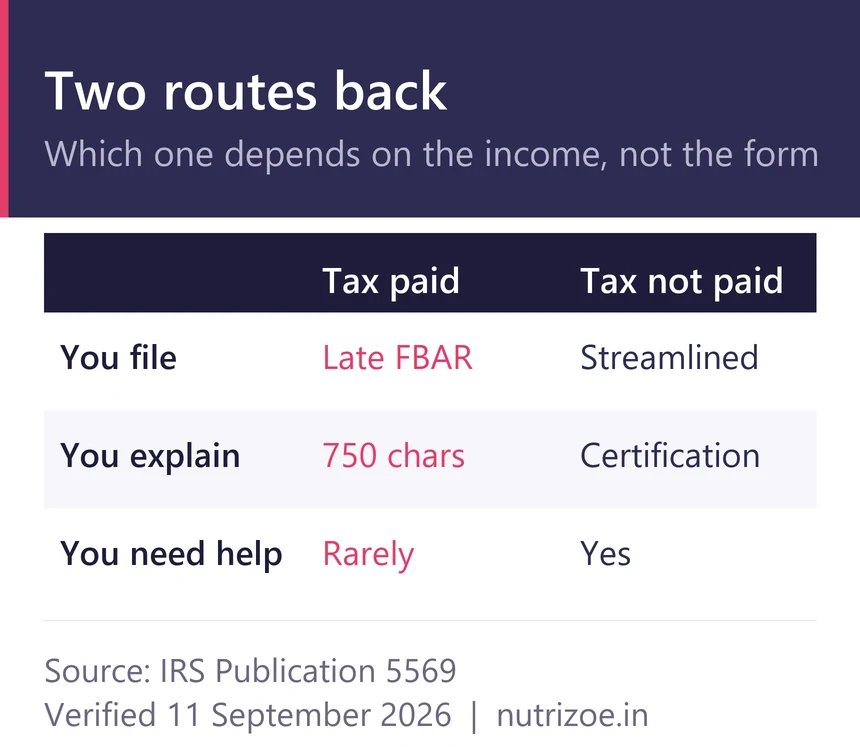
Unreported foreign income puts you in the streamlined filing compliance procedures, which involve amended returns and a signed certification that your conduct was non-willful. Signing a certification about your own state of mind, in a document the IRS keeps, is not a DIY afternoon. Pay a cross-border tax professional. It’s the cheapest part of that situation and I’d say the same thing to a friend.
The dividing line is clean enough to apply yourself. Missed the form but paid the tax means file the late FBAR. Missed the form and the tax means get help first.
The October date that fools people every year
The FBAR is due 15 April. Miss it and you get an automatic extension to 15 October, with nothing to request and no form to send. That sounds generous until you notice what it does to the calendar.
Plenty of people believe they missed a deadline in April when they had six more months, and a smaller group discover in November that the extension quietly expired while they were waiting for a bank statement from Pune. Both groups end up filing late for no good reason, and the second group risks a penalty over a delay of a few weeks. If you’re returning to India permanently, the accounts you open there create the same obligation the following year, which is why the checklist for moving back puts this in the pre-departure section rather than the paperwork appendix.
One more piece of timing worth knowing: the obligation only exists for years you were a US person for tax purposes. If you’re unsure which years those were, the substantial presence test calculator settles it by counting days, and it’s worth running before you file six years of reports you may not have owed. People on H1B status doing any freelance work and anyone weighing up a 401(k) while on a visa hit the same residency question from a different direction.
A note on where the old guidance went
For years the standard citation for this was an IRS page called Delinquent FBAR Submission Procedures. I checked it on 11 September 2026 while writing this and it returns a 404. The guidance moved into the main FBAR page and into FinCEN’s late-filing instructions, both linked above.
Worth knowing because a lot of pages still send readers to that dead URL, and arriving at a missing government page while you’re already anxious about a missed filing is a bad few minutes. If you find a figure here that no longer matches its source, tell me and it gets corrected, which is the deal set out in the editorial policy.
Then go and file the late FBAR. It takes about twenty minutes per year once you have the balances, and the version of you reading this in April will be glad it’s done.





Pingback: Moving back to India from USA: the money checklist
Pingback: FICA withheld on OPT? How to get your FICA tax refund
Pingback: Forgot to file Form 8938? Penalty, relief and what to do
Pingback: H4 EAD RFE response time: the 12-week rule explained
Pingback: Filed a 1040 instead of a 1040NR? How to fix the return