

Visa Agent Fraud: Six NEFTs, Two Teenagers’ Accounts and a UK Job That Never Existed
When Pranati first sent me her transfer slips, I did not look at the amounts. I looked at the names.
That is an old habit from my working life. I spent years in the United States, came back to India in 2019, and I have worked on money that moves across borders ever since, my own and other people’s. When a family tells me they were cheated, the amount tells me how much it hurt. The name on the receiving account tells me how the cheating was built.
Pranati is from Warangal. Between 29 August 2025 and 28 April 2026 she paid ₹20,84,216 in six NEFT transfers for a job in the United Kingdom that was supposed to start in a restaurant, then moved to a gift shop, and never started at all. I wrote her full story in [the first part of this series](/uk-job-offer-scam-warangal/). This part is about one question only, the question I keep coming back to every time I open her folder.
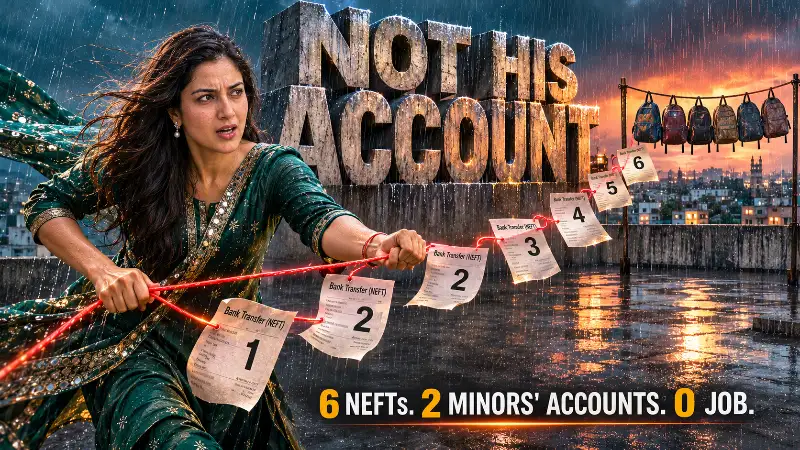
Why did not a single rupee go into the account of the men who promised her the job?
The answer is the money trail, and once you see how it is laid, you will recognise it in almost every overseas job scam that reaches Telugu families.
Where the money went, step by step, as Aradhana Sharma traced it
Why this visa agent fraud complaint starts with a name that is not on the offer
Pranati’s job was promised by two brothers, Madan Kulkarni and Piyush Kulkarni, who have lived in the UK for more than a decade. She was introduced to them by Sundar Rao, who runs an automation agency in New Delhi. All three are named as accused in the FIR her family filed in Warangal on 29 August 2026. What I describe here is her account and the account in that complaint. The court will decide what is proven.
Now look at what the brothers did not do. They did not send her their own bank details. Not once in nine months.
According to Pranati, the reason was simple, and the brothers did not even hide it well. They live in the UK with permanent status. If lakhs of rupees kept arriving in their own accounts from strangers in India, someone, a bank, a tax office, a police officer, would eventually ask them what the money was for. So they made sure that question would never be asked of them.
Instead, they gave her the account details of other people in India.
Those accounts were held in the names of minors. Children of about 14 and 15 years of age.
The people who promised the job never touched the money in their own names. That one fact told me more than the offer letter did.
I will not print the children’s names and nobody should. They are minors, and whatever happened, the people responsible are the adults who used their accounts. But the method matters, because it is not unique to this case. It is the backbone of the whole scam.
Why a fraud needs someone else’s account
A fraud has two problems. The first is getting the money. The second is keeping it without being caught. Most families only think about the first problem, because that is the part that happens to them.
The second problem is solved by distance. Every extra name between the victim and the person who finally spends the money is one more door the police have to open. If the first account in the trail belongs to a teenager in another town, the first officer who looks at the bank record sees a child, not a man in the UK.
This is what the police and the banks call a mule account: an account that receives and moves money for someone else. The Indian Cyber Crime Coordination Centre under the Ministry of Home Affairs has warned in Hindi that organised fraudsters use such mule or borrowed accounts to run illegal payment channels, and it told people plainly not to sell or rent out their bank accounts.
The RBI’s own Hindi awareness booklet, BE(A)WARE, describes money mules as people whose accounts fraudsters use to move illegal money, often lured by a small commission, and it asks people never to let anyone use their account for a fee.
Read those two lines again with Pranati’s story in mind. The children whose accounts received her money did not promise her a job. Somebody arranged for those accounts to be used. That somebody did not want to be the name on the slip.
The staircase: how six payments were built
People often ask me how a sensible family pays twenty lakh rupees to strangers. The honest answer is that they never decide to pay twenty lakh. They decide to pay a small amount, then one more, then one more.

Here is the order Pranati paid in, from her transfer records:
| Payment | Date | What she was told at the time |
|---|---|---|
| 1 | 29 August 2025 | A small processing fee to begin the file |
| 2 | 4 September 2025 | The first step is done, the next stage needs money |
| 3 | 3 November 2025 | The restaurant job is on track, the papers will follow |
| 4 | 1 February 2026 | The restaurant has closed, a gift shop manager post is ready instead |
| 5 | 7 April 2026 | The job offer letter has come, the move is happening |
| 6 | 28 April 2026 | Fly and bring the remaining money; after this, silence |
At the family’s request, I am not breaking down each amount. The total, ₹20,84,216, is the figure that matters, and the dates come straight from the slips.
The first payment is the hook. It is small on purpose. It is small enough that a family thinks, “Even if it fails, we lose only this much.” Once it is paid, the fraud has something more valuable than money: a family that has already said yes once.
After that, every new payment comes with a reason that sounds like progress. A file opened. A stage passed. A letter coming. A new job ready. And each payment makes the earlier ones more expensive to abandon. Walking away after payment four means accepting the loss of payments one, two and three. So families keep going, hoping the next step is the last step.
The first payment is never about the money. It is about getting you to say yes once.
The money trail and the paper trail move in opposite directions
Watch what happened to the paper while the money moved. In the first months there was no paper at all, only messages saying “tomorrow you will get the letter.” The offer letter only arrived after payment four, when Pranati had already invested so much that a letter was enough to carry her through the last two transfers.
That is the money trail in one sentence: the money goes out early and in steps, the paper comes in late and all at once. In a real job, it is the other way around. You see the contract and the employer first. Nobody asks the worker to fund the process in instalments.
Agent asking payment in another account: the sentence that should stop you
If you remember only one thing from this article, remember this sentence, in any language it comes to you in: “Send it to this account, it is our person in India.”
An agent asking payment in another account is the clearest warning sign in any overseas job deal, because there is no honest reason for it.
Think about who should actually receive money in a genuine process:
- Visa fees are paid to the government of the country you are going to, through its official online application, not to a person.
- An employer that sponsors you does not charge you for your own job. If anything, the employer carries the sponsorship costs.
- A registered recruiting agent in India issues receipts in its own registered business name, with its registration details on them.
- A family member’s or a friend’s account has no place in any of these.
So when the account name on your transfer is a stranger, a relative of the agent, a “processing team member”, or, as in Pranati’s case, a teenager, the arrangement exists for one purpose: to keep the real receiver’s name off your bank statement.
| What you are told | What it usually means | What I would do |
|---|---|---|
| Pay to our person in India, it is faster | The real receiver does not want to appear on the record | Refuse, and ask for the registered business account and a receipt |
| The account is in my nephew’s name, it is safe | A family name is being used to soften a mule account | Treat any personal account as a stop sign |
| Split it into smaller transfers | Smaller amounts attract less attention from banks | Ask why a legitimate fee needs splitting |
| Do not mention the job in the remarks | They are hiding the purpose of the payment | Write the true purpose, or do not pay at all |
| Pay now, the receipt will come later | There will be no receipt | No receipt, no payment |
| A different account this time | Accounts are being rotated before they get frozen | Stop and report what you have already paid |
If the name on the account is not the name on the job offer, the job offer is not the real document. The bank slip is.
Minors’ bank accounts in fraud: why children’s accounts are chosen

When I first heard that Pranati’s money went into accounts held by 14 and 15 year olds, I wanted to know why anyone would choose a child’s account over an adult’s. The longer I thought about it, the colder the answer became.
Banks in India allow minors above a certain age, under RBI rules ten years and above, to open and run a savings account on their own within limits the bank sets. Many families open such accounts for school fees, scholarships or simply to teach saving. These accounts are real, active and linked to UPI and net banking.
For a fraudster, a minor’s account offers three things:
- Less suspicion at the start. A teenager’s account rarely has a history of large business transactions, so it does not look like an obvious mule.
- A shield in front of the adults. When the police trace the money, the first name on the record belongs to a child. Questioning a minor is slow, sensitive and has to follow child-protection rules.
- Control through someone close. A minor’s account is usually reachable through an adult in the same house or circle, which means the person who controls the money may not be the person whose name is on the passbook.
I am not saying the families of these children knew everything. I do not know that, and Pranati’s complaint is the place for that question to be answered. I am saying that using a child’s account is a deliberate choice, and anyone who asks you to send money to one is telling you exactly what kind of deal you are in.
A money mule account in India is often rented, not stolen
Telugu newspapers have been reporting how ordinary young people are offered small payments to let fraudsters use their accounts. Eenadu reported cyber fraudsters luring youths to rent out their bank accounts with an offer of about ₹1,000 for every lakh passed through. The same paper has reported on new RBI rules proposed for money mule accounts, which shows how seriously the banking system now treats this.
This matters for two kinds of readers.
If you are the person being cheated, it tells you that the account you are paying into may belong to someone who has never met your agent, which is why “but it is a real person’s account” is no comfort at all.
If you are a parent, or a young person who has been offered “easy money” to share an account, it tells you that the account holder is the first person the police will knock on. Renting out your account, or your child’s, is not a side income. It is how you end up inside someone else’s fraud case.
What Pranati did right, and what I would add
Pranati lost a great deal of money. She did not lose her records, and that is why her case is moving.
Here is what she kept, and what every family should keep from the very first payment:
- Every transfer slip with the date, the amount and, most important, the UTR or reference number of the NEFT.
- The receiving account details exactly as they were given to her, including the account holder’s name as it appeared during the transfer.
- Every chat, especially the messages that told her which account to use and why.
- Call recordings of the conversations where payments were asked for.
- The offer letter and every message promising it.
- A simple timeline in her own words: date, what was promised, what was paid.
When the FIR was filed in Warangal, this folder did the explaining. Six slips, six dates, the same pattern each time. A police officer does not need to be convinced by emotion when the bank trail speaks for itself.
Your bank slip is evidence. Treat it like a property document, not like a shopping receipt.
How to file a visa agent fraud complaint the day you suspect it
This is where speed decides everything. Money that has just landed in a mule account is often moved again within hours. The faster a complaint reaches the bank, the better the chance that some of it is still sitting there and can be held.

If you have paid an agent and something now feels wrong, do these in order, the same day:
- Call 1930. It is the national cyber crime helpline. For online and bank transfer fraud, this is the fastest way to get your complaint into the system that alerts banks. The Union Home Minister reviewed the 1930 helpline in June 2026, and the Government said around one lakh citizens had already benefited from the money restoration mechanism.
- File on the national cyber crime portal at cybercrime.gov.in, with every UTR number and the receiving account details.
- Call your own bank’s fraud line and ask, in writing afterwards, for the receiving accounts to be flagged. Your bank cannot simply pull back an NEFT that has been credited, but it can pass your complaint to the receiving bank quickly.
- Go to your local police station with a printed timeline and copies of everything, and ask for the complaint to be registered.
- Stop all further payments, no matter what you are told. “Pay one more time and everything will be released” is the most common last step of these scams.
The Government’s backgrounder on curbing cyber fraud, in Hindi, describes the scale of what the 1930 system now handles. Your complaint will be one of many. Make it the one with the clearest records.
A note for families who paid months ago
Pranati’s last payment was on 28 April 2026, and the FIR came on 29 August 2026. Many families wait even longer, out of shame or because the agent keeps promising “one more week.” If that is you, report it anyway. A late complaint may not freeze money that has already moved, but it adds your slips to the same trail other victims are building. In cases like this, where somewhere between 9 and 15 people from Andhra Pradesh and Telangana appear to have paid the same network, every additional complaint makes the pattern harder to deny.
The other families on the same money trail
Pranati is not the only one who paid into this trail. Through her, other victims from both Telugu states have reached me. Their amounts differ. Some paid less, some borrowed against family gold to keep up with the instalments, some were brought in through the same broker after hearing that earlier families had “gone successfully.”
That last detail is the cruelest part. The early families who went abroad were the advertisement. Their success, real or partial, was the reason the next families trusted the process. And some of those early families now say they too were cheated.
When I lay their stories side by side, the shape is the same:
- An introduction through someone known.
- A small first payment.
- Payments into accounts that do not belong to the people promising the job.
- Paper that arrives late and convinces the family to finish paying.
- Silence after the last transfer.
The money trail does not change much from family to family. The faces change. The accounts change. The method stays.
What your bank can and cannot do once the money has moved

Many families believe the bank can simply cancel an NEFT the way a shop cancels a bill. I understand why. The money left your account a few hours ago, the bank has the record, so surely it can bring it back.
It does not work like that. Once an NEFT is credited, the money belongs, in the bank’s records, to the receiving account. Your bank cannot reach into another bank and take it out. What your bank can do is pass your fraud complaint to the receiving bank as quickly as possible, so that the receiving bank can look at the account and, where the rules allow, hold whatever is still sitting in it while the police examine the case.
That is the whole reason speed matters. A mule account is not a savings account. Money that arrives in it is usually sent onward, to another account, to cash, or out of the country, often within hours. If your complaint reaches the receiving bank while the money is still there, there is something to hold. If it reaches them after the account has been emptied, the hold protects nothing.
This is also why the 1930 system exists. It is built to get your complaint to the banks involved faster than a family could manage by visiting branches one by one. Use it first, then follow up with your own bank in writing, so there is a dated record that you asked.
Two practical points that families often miss:
- Ask for an acknowledgement number from 1930 or the portal and write it on the first page of your folder. Every later conversation, with the bank or the police, starts with that number.
- Do not argue with the agent once you have reported. Do not threaten them with the police on the phone. Every warning you give them is a warning to move whatever money is left.
For parents: when someone asks to use your child’s account
This part is not for victims. It is for the parents in every colony and village who have opened a savings account for a son or daughter in school.
Somebody may come to you, or worse, directly to your child, with a simple request. “A friend abroad needs to receive some money for a few days. Can we use the account? We will give you something for the trouble.” It may come from a relative. It may come with a smile and a box of sweets.
Please say no, every time.
Your child’s account is linked to your family’s name, your address and often your own phone number. If money from a fraud passes through it, the first door the police knock on is yours, and the first person they need to question is your child. You may have done nothing except trust the wrong relative, but you will spend months proving that.
If someone has already used your child’s account in this way, do not wait to be found. Go to your bank, ask for the account statement, and go to the police with it yourself. A family that comes forward on its own is in a very different position from a family that waited.
A child’s savings account should hold birthday money and scholarship money. Nothing else.
How I check any payment request now
After Pranati, I gave myself a rule for every family that asks me to look at an overseas job deal before they pay. I ask them to read me the name on the receiving account, out loud, before anything else. Then I ask four questions:
- Is this the name of the employer, a government, or a registered agency? If it is a person, stop.
- Is there a receipt in the same name? If not, stop.
- Has this account changed since the last payment? If yes, stop and report.
- Would you be comfortable showing this slip to a police officer tomorrow? If you hesitate, you already know the answer.
These questions take five minutes. They do not need English, a lawyer or a laptop. They need someone in the family willing to say “wait” before the money moves.
What this visa agent fraud complaint should change for Telugu families
I am a licensed financial analyst, and I spend my days on boring things: tax years, remittance rules, residency dates. Fraud is not my specialty. But money is, and every fraud is, in the end, a story about where money went.
Pranati’s story is not only about a fake job in the UK. It is about how easily a family’s savings can be moved through other people’s names, children’s names, so that the people who planned it stay clean on paper.
You do not need to understand UK immigration law to protect yourself from this. You only need to look at one line on your transfer screen: the name of the person receiving your money. If that name is not the employer, not the government and not a registered agency, the deal is not what you were told.
If you are in the middle of an overseas job deal right now and something in this article sounds familiar, write to me through the contact page here before your next payment. I would much rather read your message today than your transfer slip next month.
Questions People Ask About a Visa Agent Fraud Complaint
Why did the UK job agents in Pranati’s case never use their own bank accounts?
According to Pranati, the brothers live in the UK with permanent status, and regular deposits from strangers in India would have drawn questions to them. So payments were sent by NEFT to accounts in India held by minors, which kept their own names off the money trail.
What is a money mule account in a job scam?
It is a bank account that receives and moves money for someone else, so the real receiver stays hidden. Government and RBI awareness material warns people never to sell, rent or lend their accounts, because the account holder is the first person investigators reach.
Is it ever safe to pay a visa agent into a third-party account?
No. Visa fees go to the government through the official application, sponsoring employers do not charge workers for their own jobs, and registered recruiting agents issue receipts in their registered name. A third-party account, and especially a minor’s account, is a warning sign.
How do I file a visa agent fraud complaint after paying by NEFT?
Call 1930 the same day, file on cybercrime.gov.in with every UTR number, ask your bank’s fraud desk to alert the receiving bank, file a written complaint at your police station, and stop all further payments.
Can I still complain if my last payment was months ago?
Yes. A late complaint may not freeze money that has already moved, but it adds your evidence to the same trail other victims are building, which strengthens the case against the people behind it.