


An F1 visa rejection under 214(b) can turn an ordinary family evening into a race against university deadlines. In this representative scene, Meghna Joshi calls from Jaipur after her interview. Her mother is close enough to hear both sides of our free call. Meghna has an offer for a US master’s in supply chain analytics, a deposit deadline from the university, and a paper saying her F-1 visa application was refused under section 214(b). Her mother asks whether they should book another appointment while slots are available. I let Meghna finish telling me what happened. The refusal has made the room feel urgent; a lecture about immigration law would be the wrong first response.
The question I would ask Meghna is small and uncomfortable: what would the next officer learn that the first one did not? The answer is not automatically “a thicker folder.” If the course, the explanation for choosing it, the available funds, and her circumstances are exactly the same, a new appointment is a new application, not a reset button.
I have heard students speak about refusal as if it is a verdict on their intelligence or ambition. It is not a reliable measure of either. But I would not soothe Meghna by calling 214(b) a harmless delay, either. A refusal has happened. She tells me she still likes the course; that is something worth listening to, separate from the pressure to rescue a deposit. The useful work now is to understand what that code means, what cannot be appealed in that application, and whether a later application can honestly present something material that has changed. Her university’s calendar keeps moving while she considers all of that.
Meghna’s decisions after the interview
The first evening is for reading the refusal, not booking another slot
A family can easily mix three different events into one word, rejected. A document request under 221(g) is not the same as a completed 214(b) refusal. A visa appointment that has not happened is different again. I would ask Meghna to read the section on her actual notice before following advice from a cousin whose case had a different result. Our separate guide to what a 221(g) notice can mean explains that route; it should not be used to rename a 214(b) decision.
The US Department of State’s visa-denials page says 214(b) can mean an applicant did not sufficiently establish qualification for the requested nonimmigrant visa category and/or did not overcome the statutory presumption of immigrant intent. Officers consider the application individually, including the person’s circumstances, travel plans, finances, and ties outside the United States. A code printed on the notice does not give me a transcript of what the officer thought about every answer. I would not invent one for Meghna.
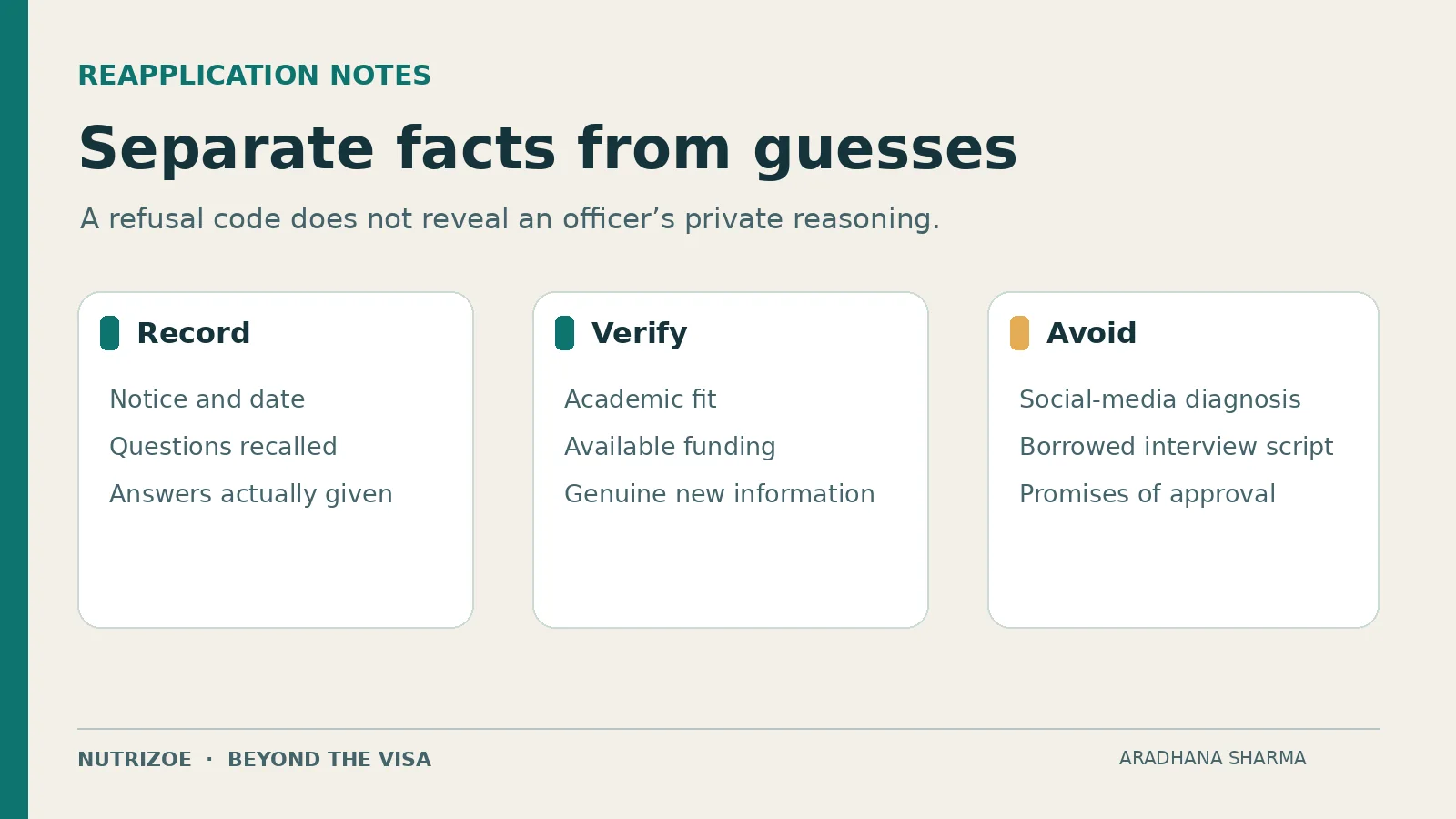
She may remember one question particularly vividly. Perhaps she was asked why this programme fits her studies. Perhaps funding came up. A student can replay those few minutes all evening and decide one imperfect sentence caused everything. That is understandable, but memory of a short interview is not a private explanation from the consulate. I would write down what she actually remembers, separate from what family and social media later guessed.
Meghna’s first practical task would be to keep the notice and application records together. Her second would be to email the university: what is the last date to accept the offer, is the deposit refundable or transferable, and can admission be deferred if she needs more time? I would ask her to keep the email short. The admissions office does not need a long account of what an officer may have thought; it needs the question about its own deadline. Those policies belong to the school, not the consulate. A family should not lose money while waiting for an answer it could have requested in writing.
Her mother might still ask me, “But if the officer did not ask to see the bank papers, did the papers matter?” I would be careful with that question. An interview can end without every document being requested. That does not let me identify the decisive issue from outside the consulate. We can record which documents Meghna carried, what the officer actually asked, and what she answered. Then we can distinguish the gap she can explain from a theory she cannot verify. I would not let an online story about somebody else’s twenty-second interview become a diagnosis of hers.
I would also ask Meghna to put the university email ahead of the family WhatsApp discussion. A short written reply about the deposit and deferral will give them a date and a policy they can use. Another relative’s confident prediction about visa appointments will not change the school’s contract. Even if the answer is disappointing, it turns a vague fear into a decision with a deadline.
What would be different in a second F-1 application?
The Department of State says a 214(b) refusal is for that particular application; it is not a permanent bar. There is no appeal process for that closed case. A person may reapply with a new application, new fee, and new interview, and should be able to show significant changes in circumstances or additional information that should be considered. That is a real route, but it is not a promise that a second officer will approve the visa. I would put that distinction plainly in front of Meghna before her family pays again.
I would divide her notes into three columns. This is a thinking aid, not a checklist that guarantees a visa.
| What is known | What needs an honest answer | Who can confirm it |
|---|---|---|
| The refusal cites 214(b) | What relevant circumstances or information are different from the last application? | Meghna and her actual records |
| The university has offered a place | Why does this specific programme fit her preparation and plans? | Meghna and the university’s programme information |
| The family has a funding plan | Are the tuition, living, and travel costs genuinely covered? | Family, lender, sponsor, and written terms |
| The intake has a deadline | Can the place or deposit move to a later start? | University admissions and international office |
I would not tell her that buying property, acquiring a last-minute certificate, or changing a sentence in a rehearsed answer is a guaranteed fix. The student-visa guidance says an officer may ask for evidence of academic preparation, intent to depart after study, and how education, living, and travel costs will be paid. Those are real questions, but the officer still makes an individual decision. The aim is to present Meghna’s truthful plan coherently, not manufacture a more impressive life on paper.
The course title matters here because Meghna should be able to say why she chose it without borrowing a consultant’s speech. I would ask what she studied, which part of supply chain analytics caught her attention, and what she hopes to do with that training. A BCom graduate, an engineer, and someone already working in logistics might have different truthful answers to the same question. I have not seen Meghna’s academic documents in this representative scene, so I would not write a tidy career explanation for her. I would listen for whether the explanation is hers.
A university course may genuinely be a better fit after a student researches it more deeply. A funding source may genuinely change. A student may obtain relevant experience or make a different academic choice. I cannot say whether any one of those changes would be significant in Meghna’s case. I can say that another interview booked solely because an earlier one hurt is a poor way to test that question.
If Meghna says, “I have exactly the same plan, but this time I will sound more confident,” I would ask her to slow down. Confidence can help her speak clearly; it is not a changed circumstance by itself. If, instead, she has learned that the proposed degree does not fit the work she actually wants, the answer may be to reconsider the course rather than polish the interview. If a new source of funding has emerged, I would ask when it became available, what conditions attach to it, and whether it covers the real costs. None of these questions is an invitation to rearrange facts until they look attractive. They help her decide whether a second application has something truthful and relevant to say.
The phrase F1 visa rejection is useful for finding this guide, but it can hide how individual the decision is. Meghna’s academic history, programme, financing, and plans are hers. A second applicant from another city may share the same code on the refusal sheet and have a very different question to answer. That is why I would work from her record rather than circulate a universal “approved answer.”
The family conversation has a second deadline: money
This is where a visa story becomes a family story. The person with the refusal notice may be thinking about shame. A parent may be thinking about the deposit. Someone else may already have calculated a loan repayment using a salary the student does not have yet. Those are different fears, and they can make a conversation feel like an argument even when everyone wants the same good outcome.
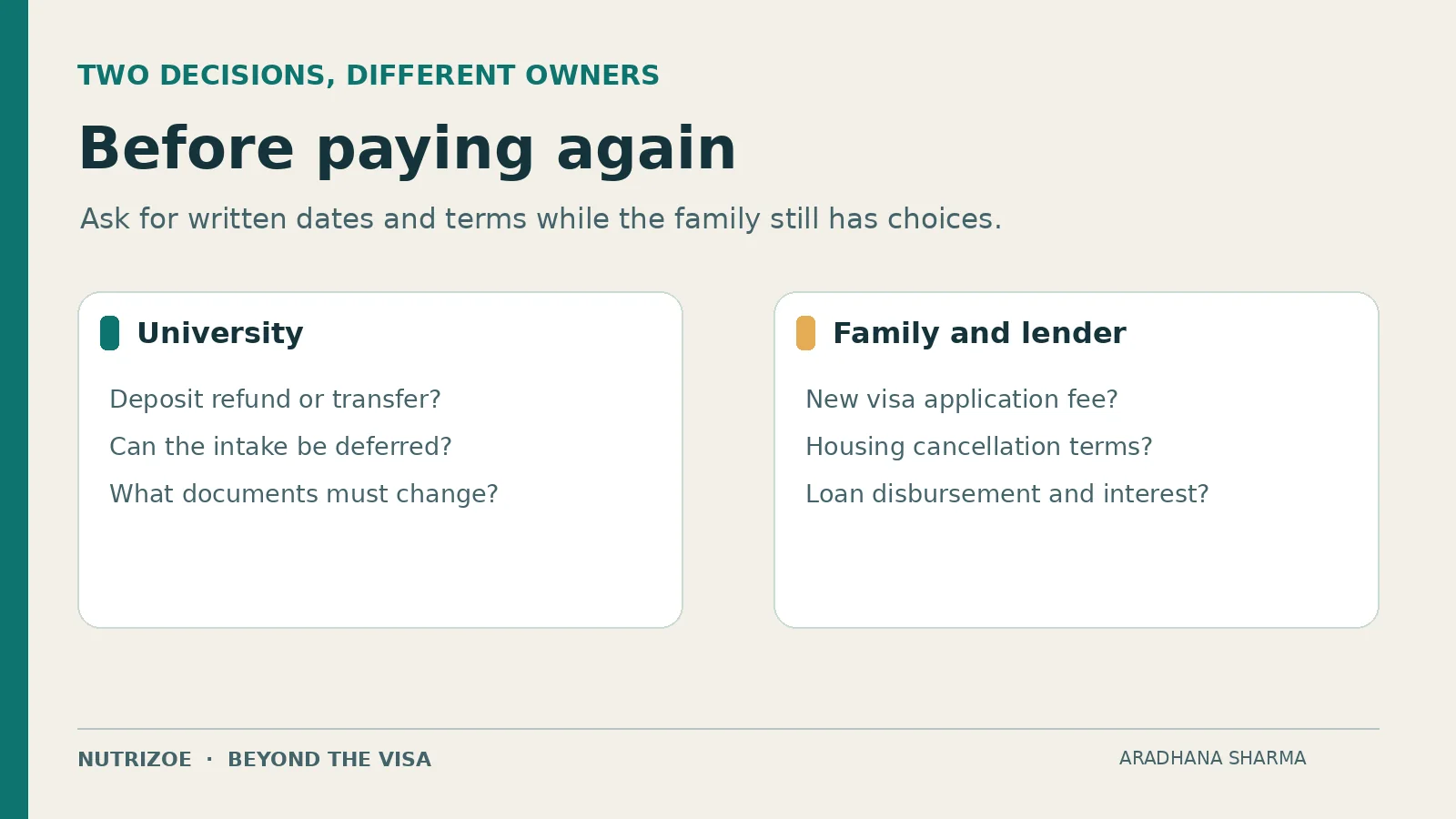
I would ask Meghna to put the costs on one sheet: the application fee already paid; a fresh application fee if she decides to reapply; university deposits; housing commitments; and any education-loan disbursement or interest that begins before classes. No universal rupee figure can replace the actual contracts. The Department of State says the visa application processing fee is nonrefundable, and a new application after a 214(b) refusal needs a new fee. The school’s refund policy and the lender’s terms must be checked with those institutions.
This connects to a question Prasad Varma raised in another discussion: what is the loan backup plan if the US master’s path changes? His story concerns a different person’s questions; I would not treat it as Meghna’s financial history. The link matters because visa uncertainty and a family’s payment schedule often meet before anyone feels ready.
If the family can wait without losing the course or taking on avoidable costs, waiting may create room for a better decision. If the university cannot hold the place, a deferral or a different plan may need discussion. I would not choose for Meghna from a fictional phone call. I would help her identify which answer comes from the school, which comes from the lender, and which is hers to make.
Imagine the mother has already promised an advance for housing because another family said rooms disappear quickly. I would ask whether that payment is actually due, what the cancellation terms say, and whether anyone has signed. I would ask Meghna whether the university can issue updated admission documents if she moves to a later intake. The school’s international office can explain its procedure; I cannot produce an I-20 or promise that an old one will cover a changed start date. A visa decision and an enrolment decision are connected, but different people control them.
I can picture the awkward pause after that. Her mother wants a yes or no: “Should we pay today?” Meghna wants to know whether pausing means giving up. I would tell them to find the latest safe decision date in the university’s written terms. If it is tomorrow, they need the school and lender answers urgently. If it is three weeks away, they have room to examine the facts before committing another payment. The point is not to make delay sound wise in every case. It is to make the amount at risk and the person who owns each answer visible to both of them.
A better explanation is not a memorised script
Some students return from a refusal and begin collecting model interview answers. I understand the impulse. The problem is that another student’s neat sentence may describe a course, family, or career plan that is not Meghna’s. An officer can ask a follow-up question. A memorised explanation is fragile when the facts beneath it are borrowed.
I would ask her to explain, in her ordinary words, why this programme is worth its total cost. What did she study before? Which part of the curriculum does she actually need? How does that connect to work she could plausibly do after graduation, including outside the United States? How is the first period of study funded? These are questions for her to think through, not lines to repeat word for word to an officer.
The earlier Aakruthi article covers a different worry: how social media, documents, and later work choices can become tangled in a student’s planning. Aakruthi did not give me a personal 214(b) refusal story. I would keep her account in its own lane while pointing a worried reader to the related questions it raises.
There is also a limit to my role. I can help Meghna make a clear list of questions and read the official requirements. I cannot see a consular officer’s private reasoning, guarantee a result, or advise her to hide a fact. If her refusal notice cites a different ground, or the circumstances include a complex immigration history, she needs advice appropriate to those facts rather than a generic reapplication story.
I might ask her to practise explaining the choice to her mother before she thinks about another visa interview. Not a mock interview with rehearsed replies: just a conversation. Why this university rather than the alternatives she considered? Which courses or facilities justify the cost? What work does she hope to pursue with that training? What will the family do if the start date moves? If Meghna cannot yet answer, that is useful information for her own decision. If she can answer naturally, she has understood the plan in a way a scripted paragraph cannot create.
Nor would I ask her to prove that every future detail is certain. Students can have thoughtful plans without knowing the exact employer or city where they will live years later. The honest answer should be specific about what is known and candid about what remains a possibility. The official student-visa requirements still govern what she must establish; a compelling story on a blog cannot replace them.
When I would stop talking about the interview
The visa can take over a family’s entire vocabulary. Every conversation becomes about a slot, a counter, a document, or another student’s result. At some point I would bring Meghna back to why she chose the degree. If the programme is valuable only when a particular visa or salary arrives on a particular date, that is a financial assumption the family should see clearly. If the education remains worth pursuing on a later timeline, a deferral is not a personal defeat.
I would end the free call without pretending to know her next result. I would want her to leave with the notice understood, the university’s deadlines requested in writing, the family’s exposure to deposits and borrowing visible, and a truthful answer to what has changed. That is more useful than promising that the next interview will be different simply because it is the next one.
Meghna and this conversation are a fictionalized representative scene, not a transcript of an identifiable caller. The visa rules above are linked to official sources; no outcome is attributed to a real applicant.
Questions I would answer before Meghna pays for another interview
Can I appeal an F-1 visa 214(b) refusal?
No. The Department of State says there is no appeal process for that closed application. You may reapply through a new form, fee, and interview if you have additional information or significant changed circumstances to present.
How soon can I reapply after a 214(b) refusal?
The official guidance does not make a fast reapplication an approval strategy. Check the embassy or consulate’s current reapplication procedure and ask what is genuinely different in your case before paying again.
Is 214(b) the same as 221(g) administrative processing?
No. The State Department describes different grounds. Read your actual notice: a 221(g) case may involve requested documents or further processing; a closed 214(b) case has no appeal within that application.
Will a larger bank balance guarantee an F-1 visa?
No. Funding is one part of student-visa qualification. The officer may also consider academic preparation and intent to depart after the course. Show genuine available funds and a coherent plan; no document guarantees issuance.
Should I pay my university deposit while deciding whether to reapply?
Ask the school in writing when the deposit is due and whether it is refundable or transferable to a later intake. Compare that answer with the family’s actual budget before committing.