

Look, I am going to be straight with you.
Every few weeks, some new AI model drops. LinkedIn blows up. YouTube fills with thumbnails. Everyone acts like the world just changed forever. And then? Nothing. You try it, get the same average results, and go back to whatever you were using before.
So when Kimi K2.7 Code dropped on June 12, 2026, I expected the same drama. Same noise. Same disappointment.
But this one? This one is different. And I am not saying that to sound cool or to get clicks. I am saying it because within a few hours of playing with it, I had a 3D game running, a fully edited AI-generated video rendered, and a mini operating system built, with apps, a clock, a notes section, a calculator, everything. All with one model. All without writing a single line of code myself.
If you are a freelancer sitting there wondering whether this is just another chatbot with a fancy name, I need you to stay with me for the next few minutes. Because what Moonshot AI just released might actually change how you work, what you can offer clients, and how much you can charge.
Table of Contents
What Exactly Is the Kimi K2.7 Code Model?
Let me keep this simple, because you do not need a PhD to understand this stuff.
Kimi K2.7 Code is the latest open-source coding model from Moonshot AI, a Beijing-based AI company. This is not a chatbot. This is a builder.
It uses a Mixture-of-Experts (MoE) architecture with 1 trillion total parameters, but only 32 billion parameters are active at any time, which means it is both powerful and efficient. The context window is 256,000 tokens, which means it can read, plan, and execute across massive amounts of information without forgetting what it started doing.
And the biggest thing? It is designed specifically for long-horizon agentic coding tasks. That means it does not just answer your question and stop. It plans, executes, finds bugs, fixes them, and keeps going until the job is actually done.
“It writes whole apps from a single sentence, runs them, finds the bugs, fixes them again and again until it works.”
That is not marketing copy. That is what it actually does.
Why Should a Freelancer Even Care?
Here is the thing most people miss. You do not need to be a coder to use this. You do not need to know Python. You do not need to know what MoE architecture even means beyond what I just told you.
What you need to understand is this: Kimi K2.7 Code model lets non-technical people build technical things.
As a freelancer, your two biggest problems are:
- You cannot afford to hire developers for every project
- You cannot charge premium rates without premium deliverables
This model solves both. When you have a tool that can build apps, generate videos, write code, debug itself, and operate autonomously, you become a one-person studio. And one-person studios that produce agency-level output? They charge agency-level rates.
Kimi K2.7 Code vs ChatGPT vs Gemini vs Claude Opus: The Honest Comparison
Let us address something directly.
ChatGPT is everywhere. Gemini shows up in every Google product. They have massive brand recognition. And honestly? For casual conversations, writing emails, or summarising documents, they work fine.
But for agentic coding work, for building apps, running multi-step tasks, and actually completing long projects without holding your hand every five minutes, the comparison does not look so comfortable for them.
Here is the benchmark picture as of June 2026, based on Moonshot AI’s own published data (note: these are company-reported benchmarks, not all independently verified yet):
| Benchmark | Kimi K2.7 Code | Claude Opus 4.8 | GPT-5.5 |
|---|---|---|---|
| Kimi Code Bench v2 | 62.0 | 67.4 | 69.0 |
| MLS Bench Lite | 35.1 | 42.8 | 35.5 |
| MCP Mark Verified (Tool Use) | 81.1 | 76.4 | 92.9 |
| Program Bench | 53.6 | – | – |
| Thinking Token Reduction | -30% vs K2.6 | – | – |
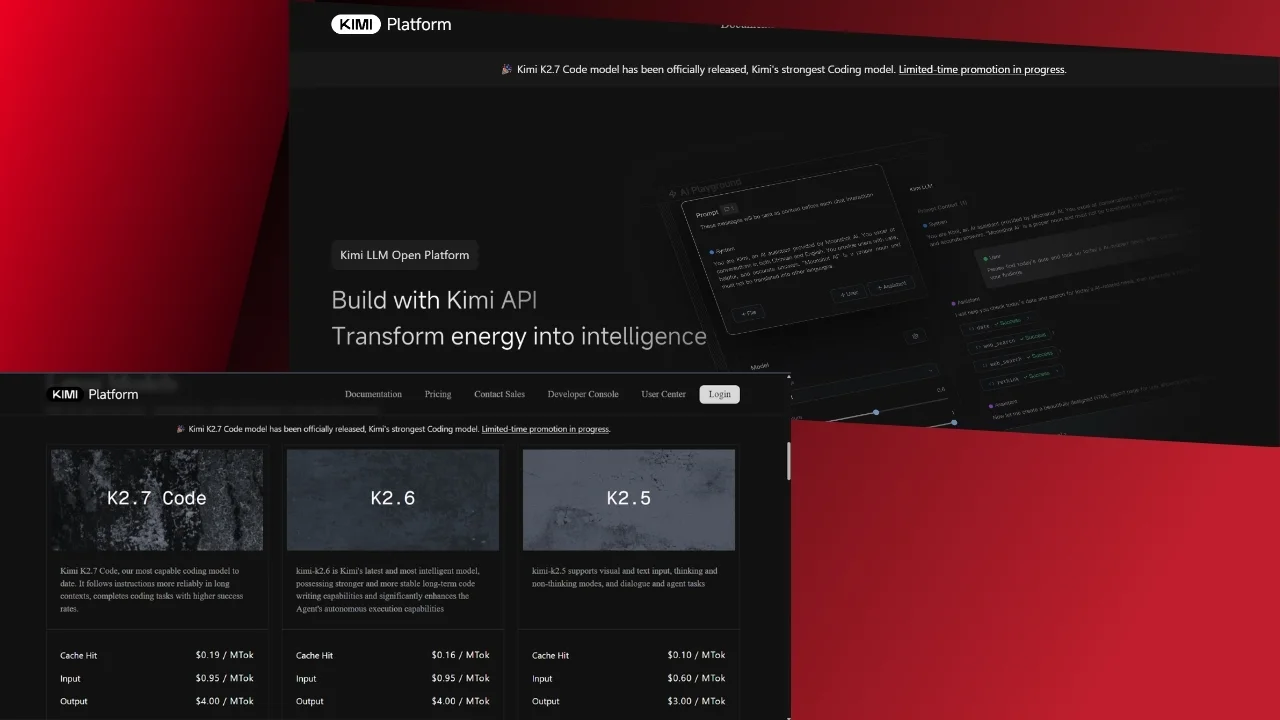
| API Price (input/output per 1M tokens) | $0.95 / $4.00 | $5 / $25 | $5 / $30 |
Sources: Moonshot AI model card, Codersera comparison
Now look at that pricing column again.
Kimi K2.7 Code is roughly 5 to 7 times cheaper per token than Claude Opus 4.8 and GPT-5.5. And on the MCP Mark Verified benchmark, which tests how well a model actually uses tools in real agentic workflows, it scores 81.1% versus Claude Opus 4.8’s 76.4%. It beats a model that costs five times more, specifically on the skill that matters most for automated workflows.
Does GPT-5.5 still lead on overall raw coding? Yes, it does. Does Claude Opus 4.8 have a better proven track record with independent SWE-bench numbers? Yes. Full transparency here. But if you are a freelancer running 100 automated tasks a month, paying 5x more per token is not a “slightly worse deal.” It is a business model problem.
And Gemini? It is fine for Google Workspace tasks. But for long-horizon autonomous coding agents? It is not even in this conversation right now.
What Kimi K2.7 Code Model Actually Did in a Real Test
Here is where it gets genuinely mind-blowing.
Using Kimi K2.7 Code plugged into the Hermes agent system, here is a list of what was built in a single session within a few hours of the model dropping:
- A fully edited AI avatar video with voice, face, music, and transitions
- A 3D game with a navigable landscape, like a Skyrim-style RPG
- A web operating system with working apps (notes, calculator, clock, paint)
- A show reel video compiled from created assets
- Multiple animated portfolio pieces with mouse-tracking interaction
The web OS alone should stop you for a second. A functional operating system, built in hours, with a notes app that saves your notes and reopens them correctly, a calculator, a paint tool, a working clock. All from a single model, working autonomously, judging its own output, and iterating until it hit quality.
The video production workflow specifically used a multi-agent team structure:
- A producer agent generated the avatar video using Hey Gen
- An editor agent assembled and edited the footage
- A judge agent watched the video, scored it, and sent it back for revision until it hit 9 out of 10
That judge scored it 6. Then 7. Then 9. And only then approved it. It did not accept average work from itself. That is what autonomous quality control looks like.
The whole edited video took roughly 90 minutes to produce. Not perfect. But better than a lot of what human editors turn in. And it cost almost nothing compared to hiring a video team.
How Hermes Agent + Kimi K2.7 Code Works Together
Let me explain this setup so you actually understand what is happening and how you can replicate it.
Hermes is an open-source autonomous AI agent built by Nous Research. It is not a chatbot. It is an agent that lives on your server, keeps persistent memory, and gets smarter the longer it runs. Think of it as the operating brain, the manager, the coordinator.
Kimi K2.7 Code is the worker. The builder. The one who actually writes the code, creates the video, fixes the bug.
When you plug Kimi K2.7 Code into Hermes as a model, you are essentially hiring a brilliant developer and putting them into a team structure where they get assigned tasks, judged on their output, and iterated until the result is good.
The workflow looks like this:
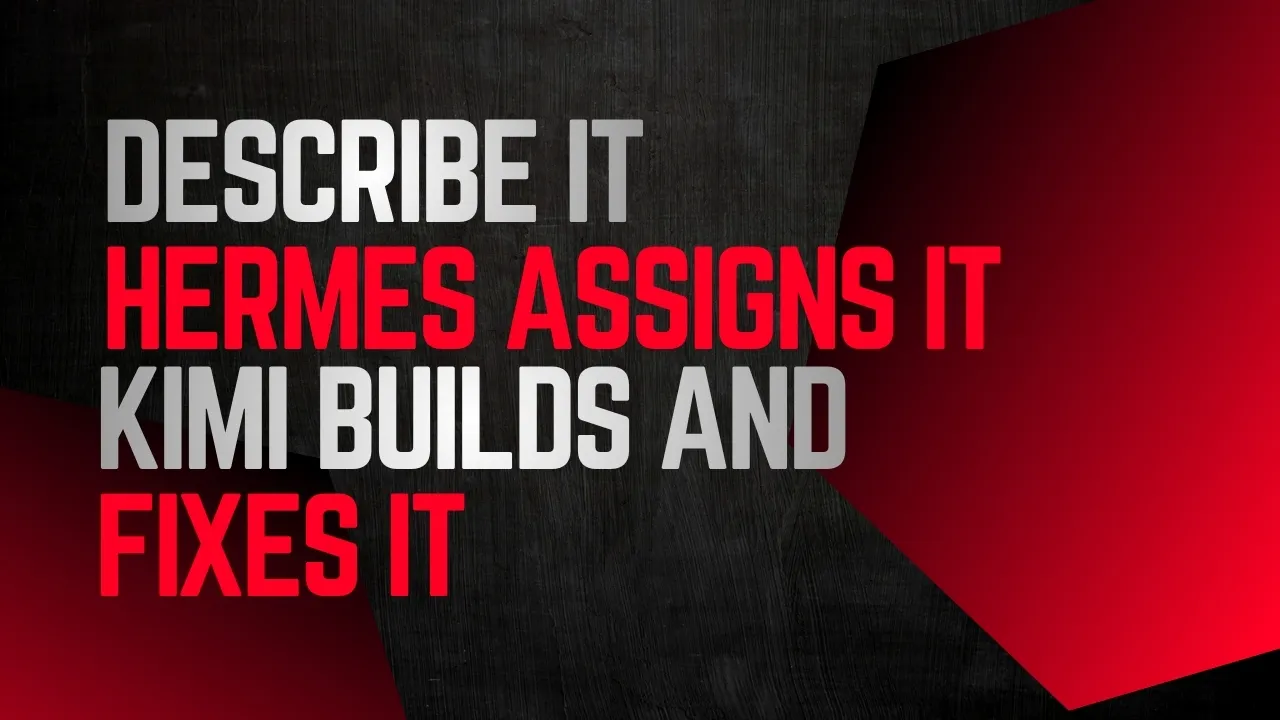
- You describe a task to Hermes
- Hermes triages it and assigns subtasks to different agents
- Each agent has a role: producer, editor, script writer, judge, developer
- Kimi K2.7 Code acts as the brain for these agents
- The judge agent reviews the output and scores it
- Agents iterate until the score hits the acceptable threshold
- You get the final output
The Kanban-style task board (called Camb board in the system) keeps track of everything. You can see what each agent is doing, what it has produced, and how the judge scored it.
For a freelancer, this means you can run multiple client projects simultaneously, with agents working in parallel, while you sleep.
Step-by-Step: How to Start Using Kimi K2.7 Code Model as a Freelancer
You do not need to be technical. Here is a practical path:
Step 1: Get Access to Kimi K2.7 Code
Go to kimi.com and sign up. The model is available via API and also through the Kimi Code CLI. Pricing starts at $0.95 per million input tokens and $4.00 per million output tokens. For the coding subscription plan (Kimi Code), there is a Moderato plan at approximately $19 per month that gives you more tokens in bulk.
If you want to self-host, the full model weights are available on Hugging Face under a Modified MIT License, which allows commercial use with attribution.
Step 2: Install Hermes Agent
Go to hermes-agent.org or the Hermes GitHub repository. Install it on your server, VPS, or local machine. Hermes installs with a single curl command and supports Linux, macOS, and WSL2 on Windows.
If you are not technical enough to self-host, look at the cloud-hosted version of Hermes, which is accessible directly from their website.
Step 3: Plug Kimi K2.7 Code Into Hermes
Inside Hermes, go to the model settings. Type in the Hermes model command inside your terminal, then navigate to switch to the Kimi coding plan. If you use the subscription plan, you get far more tokens than going through the raw API, so it is more cost-effective for high-volume work.
Step 4: Create Your Agent Profiles
Inside Hermes, create individual agent profiles for different roles:
- Developer agent: Kimi K2.7 Code as brain, focused on writing and debugging code
- Content agent: Kimi K2.7 Code as brain, focused on script writing and copywriting
- Editor agent: Focused on video editing tasks via connected tools
- Judge agent: Reviews output quality and sends revision notes
Each profile gets a name, a role description, and the Kimi K2.7 Code model plugged in as the thinking layer.
Step 5: Assign Tasks via the Camb Board
The Camb board is a Kanban-style task management board inside the system. Add your project task at the top, assign it to your agent team, and let the system triage, assign, execute, and iterate.
For a coding project, you describe the app in one sentence. For a video project, you provide the script or topic. For a content project, you give the brief.
The agents do the rest.
Step 6: Review the Output
The judge agent will score everything on defined dimensions. You will see iteration rounds. Do not interrupt the process too early. Let the judge run. When it approves the output, that is your deliverable.
What Freelance Services Can You Actually Offer With This?
Here is where the income conversation gets real.
If you can set up this system, you can productise the following services:
App Development Services Build simple web apps, tools, calculators, dashboards, and browser utilities for clients. Describe the app, let Kimi K2.7 Code build it, let the judge fix it. Charge per project. Clients do not need to know you used AI. They need the working app.
AI Video Production Produce faceless AI-narrated videos for YouTube channels, course creators, or product demos. The Hermes plus Kimi K2.7 setup can handle scripting, avatar generation, editing, and quality review. Package it as a recurring service.
Portfolio Website Builds Build portfolio sites, landing pages, and interactive demos for clients. Kimi K2.7 Code can handle full HTML, CSS, and JavaScript builds with complex animations from a single description.
Automated Content Systems Set up Hermes agents to run daily content tasks for clients, blog posts, social captions, product descriptions, and push them automatically. Charge monthly retainer rates.
AI Agent Setup Services Help other business owners install and configure Hermes with Kimi K2.7 Code. This is already a growing Fiverr category, with some freelancers charging $30 to $300+ for full stack AI agent system setup.
The Real Difference Between Kimi K2.7 Code Model and Every Other Tool You Have Tried
Most AI tools make you smarter. Kimi K2.7 Code model makes you capable.
That is a different thing entirely.
ChatGPT makes you a better writer. Gemini makes you a faster researcher. These are tools that enhance what you already do.
Kimi K2.7 Code lets you do things you were never able to do before. Build apps without being a developer. Produce videos without a video team. Maintain operating systems without knowing Linux. Deploy autonomous agents without touching a server configuration.
The comparison is not really ChatGPT versus Kimi or Gemini versus Kimi. The comparison is: what can you deliver to a client next month that you could not deliver this month? If the answer includes software, interactive tools, autonomous workflows, or AI-generated media, Kimi K2.7 Code model is your entry point.
What Are the Real Limitations? (No Sugarcoating)
I want to be honest here because you deserve that.
Kimi K2.7 Code is slow on quick back-and-forth tasks. If you are using it for browser control or real-time computer use, expect 7 to 10 second response delays per action. That adds up fast if you are doing simple tasks that any lighter model could handle in a second.
The benchmarks are mostly Moonshot’s own published numbers. Independent verification is still catching up as of June 2026. Claude Opus 4.8 still has a stronger proven track record on SWE-bench Verified, which is the gold standard independent benchmark for real software engineering tasks. GPT-5.5 still leads on MCP Mark Verified overall at 92.9% versus Kimi’s 81.1%.
So do not treat this as “Kimi beats everything.” It does not. It beats on cost. It beats on tool use versus Claude Opus 4.8. It is open-source and self-hostable. And for long autonomous tasks, it is seriously competitive.
Use it for what it is built for: long-horizon autonomous coding and agent work. Do not try to use it as a customer support chatbot or a quick question answering tool. That would be like using a bulldozer to park a car.
Kimi K2.7 Code Model: Technical Specs at a Glance
| Spec | Details |
|---|---|
| Model Type | Mixture-of-Experts (MoE) |
| Total Parameters | 1 Trillion |
| Active Parameters | 32 Billion per token |
| Context Window | 256,000 tokens |
| License | Modified MIT (commercial use with attribution) |
| Release Date | June 12, 2026 |
| API Input Price | $0.95 per 1M tokens |
| API Output Price | $4.00 per 1M tokens |
| Cached Input Price | $0.19 per 1M tokens |
| Hugging Face | moonshotai/Kimi-K2.7-Code |
| Best For | Long-horizon agentic coding, multi-step tool use |
Why Non-Technical Freelancers Are the Biggest Winners Here
Here is what the technical crowd misses entirely.
For a developer, Kimi K2.7 Code is a powerful tool that makes their existing workflow faster. Cool, but not life-changing.
For a non-technical freelancer? This is a category jump. Suddenly the barrier to offering software development, AI video production, or autonomous content systems is not your technical skill level. It is your ability to describe clearly what you want, manage the output quality, and deliver to a client.
That is a completely different market. And it is mostly empty right now because most people are still treating AI as a typing assistant.
You can be a freelancer who delivers working software without writing code. You can run an AI video production studio without knowing video editing. You can manage automated content pipelines for clients without knowing programming.
The tool is here. The question is whether you are going to use it.
FAQ: Kimi K2.7 Code Model for Freelancers
Q: Is Kimi K2.7 Code model free to use?
It is not entirely free, but it is affordable. The API costs $0.95 per million input tokens and $4.00 per million output tokens. The Kimi Code subscription plan starts at around $19 per month. The model weights are free to download from Hugging Face under a Modified MIT License if you want to self-host. For most freelancers, the subscription plan is the most practical starting point.
Q: Do I need coding knowledge to use Kimi K2.7 Code model?
No. The model is designed for natural language instructions. You describe what you want to build, and it builds it. For the Hermes agent setup, basic familiarity with a terminal helps, but there are cloud-hosted versions that remove even that barrier. The creator of this system himself describes as non-technical.
Q: How is Kimi K2.7 Code model better than ChatGPT for freelancers?
ChatGPT is a general-purpose conversational model. Kimi K2.7 Code is a specialised agentic coding model. On MCP Mark Verified tool-use benchmarks, Kimi K2.7 scores 81.1% versus benchmarks where ChatGPT-equivalent models focus on different categories. More importantly, Kimi K2.7 Code is 5 to 7 times cheaper per token than comparable closed models, making high-volume freelance workflows economically viable.
Q: What is the difference between Kimi K2.7 Code model and Hermes agent?
Hermes is the agent framework, the system that manages tasks, memory, agent profiles, and workflow orchestration. Kimi K2.7 Code is the AI model that powers the thinking and building inside that framework. You need both working together to get the full autonomous team experience described in this post.
Q: Can I use Kimi K2.7 Code model to build client apps without being a developer?
Yes, and this is exactly the use case it is built for. You describe the app, it plans the architecture, writes the code, runs it, finds the bugs, and fixes them. The judge agent inside the Hermes system ensures quality before you deliver. Independent testing at the time of this writing confirms strong benchmark performance on long-horizon coding tasks.
Q: Is the Kimi K2.7 Code model truly open source?
It is open-weight, released under a Modified MIT License. This means the full model weights are publicly available on Hugging Face and can be used commercially with attribution. It is not strictly “open source” in the OSI definition, but for all practical freelance and business purposes, you can download, self-host, and build with it commercially.
Q: How long does it take to set up the Hermes plus Kimi K2.7 system?
The cloud-hosted version of Hermes can be running in under 60 seconds. The self-hosted version with a VPS typically takes a few hours for someone doing it for the first time. Configuring agent profiles and connecting Kimi K2.7 Code takes another hour or so. By day one, you can be running real tasks through the system.
Q: What kind of freelance income is realistic with this setup?
This depends entirely on the services you build and how you package them. Existing freelancers using similar Hermes-based setups report productised services ranging from $500 to $3,000 per month per client for recurring AI agent deliverables. App builds for small businesses can range from $300 to $2,000 per project depending on complexity. AI video production packages are being sold at $500 to $1,500 per month for 4 to 8 videos. The income ceiling depends on your ability to package and sell, not on the tool itself.
My Personal Thoughts: Is Kimi K2.7 Code Model Worth Your Attention?
Yes. Fully and without hesitation, yes.
Not because it is the most powerful model in the world. Claude Opus 4.8 and GPT-5.5 still win on some important benchmarks. Not because it is completely effortless to set up. There is a learning curve.
But because Kimi K2.7 Code model is the most practical open-source agentic coding brain available right now for non-technical freelancers who want to build real things for real clients at a price that makes business sense.
It is 5x cheaper than the closed alternatives. It beats Claude Opus 4.8 on MCP tool-use benchmarks. It is self-hostable. It works autonomously. It judges its own output. And when you pair it with Hermes agent, you get a team of AI workers running 24/7 without salary, leave, or attitude.
The market for freelancers who can deliver AI-built software, autonomous content systems, and AI video production is growing fast. And right now, most of that market is empty because most people are still using AI to write better emails.